


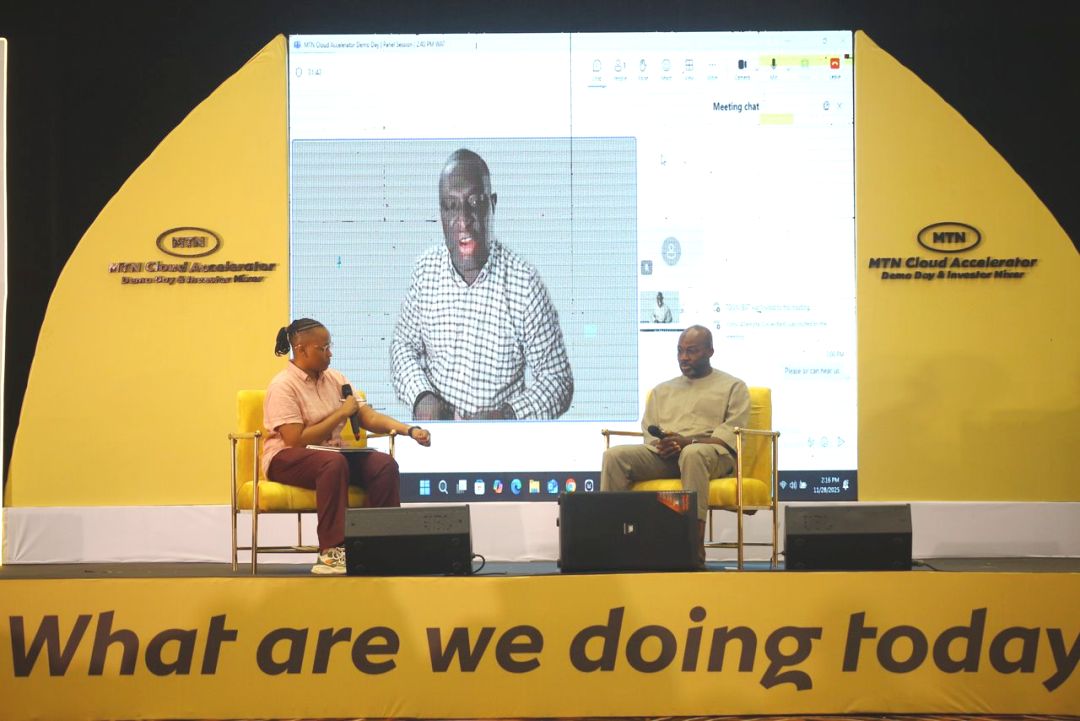
A high-level panel session at the MTN Cloud Accelerator Demo Day has underscored the urgent need for deeper corporate participation, co-creation models, and unified ecosystem collaboration to drive Africa’s next wave of innovation.
Moderated by Cynthia Chisom, programme manager of the MTN Cloud Accelerator, the panel featured:
- Babalola Oyeleye (Babs), chief strategy & innovation officer, MTN Nigeria
- Victor Asemota, a technology investor and founder, Keita Wealth Advisory (joining remotely)
The conversation explored emerging innovation trends, corporate participation in tech ecosystems, and the evolution of Africa’s investment landscape.
Startups Are Expanding Beyond Fintech
Responding to a question on innovation trends across the continent, Asemota said African founders are increasingly tackling critical gaps in health, logistics, energy, and sustainability.
He cited Trashcoin, a waste-management rewards platform, as an example of the emerging wave of impactful innovation.
“Funding will begin shifting into these new sectors,” he said. “Founders are building where the gaps are clear, and investors will follow the impact.”
Corporates Must Embrace Co-Creation, Not Transactions
Oyeleye emphasized that the traditional corporate–startup relationship, primarily transactional, is no longer sufficient.
“Co-creation is now essential,” he said. “Corporates bring infrastructure, customers and scale. Startups bring innovation and speed. When we build together, we shorten time to market and create real impact.”
He stressed that accelerators serve as outsourced R&D engines, enabling corporates to innovate faster while reducing risk.
MTN’s Evolution: From Vendor-Driven to Innovation-Driven
Reflecting on MTN’s transformation, Asemota noted that the company has made “one of the most significant shifts on the continent.”
“I’ve worked with MTN for over two decades. What I see now is different, they’re backing collaboration with real resources: cloud infrastructure, data centres, partnerships. This is not promise-driven; it’s execution-driven.”
Why Corporates Remain Cautious
Oyeleye pointed out that risk aversion remains a major barrier for many Nigerian corporates.
“When capital is limited, companies choose certainty over experimentation,” he said. “But our demographics and challenges demand deeper involvement.”

He revealed that MTN is already exploring what a more structured investment fund could look like, a natural evolution from accelerators to full corporate investment.
What Must Change in Africa’s Investment Landscape
The panelists agreed on the urgent need to expand corporate involvement in funding and acquisitions.
Asemota noted that in Silicon Valley, corporates drive majority of M&A activity, while African corporates still attempt to build everything internally.
“We need corporates to buy, invest, acquire and partner,” he said. “That’s how mature ecosystems grow.”
He also called for reduced ecosystem fragmentation through unified collaboration across investors, founders, corporates and accelerators.
Oyeleye added that access to corporate assets, especially infrastructure and regulatory support, must become easier for startups.
“Telcos have opened up. Banks and other sectors must do more. Collaboration is the way forward.”
A Call to Action
Moderator Cynthia Chisom closed the session by highlighting that Africa’s innovation future depends on coordinated action across technology builders, regulators, investors and corporates.
The panel concluded with a shared message: Africa must build boldly, invest locally, and collaborate deeply to unlock the next decade of innovation.