



Nigeria’s broadband market has crossed a significant milestone, with total subscriptions surpassing 112 million in December 2025, pushing internet penetration to 51.97%.
This marks the first time more than half of the country’s population had active broadband connections, reflecting steady growth in the sector over the past year.
Data from the Nigerian Communications Commission (NCC) shows that broadband subscriptions have grown consistently throughout 2025, rising from 91.5 million in October 2024 to 112.6 million by December 2025.
While the month-on-month growth has been gradual, averaging around 2-3 million new subscriptions per month, the overall trend highlights sustained demand for digital connectivity across urban and rural areas.
Interestingly, broadband penetration figures have followed a slightly different pattern than subscription growth.
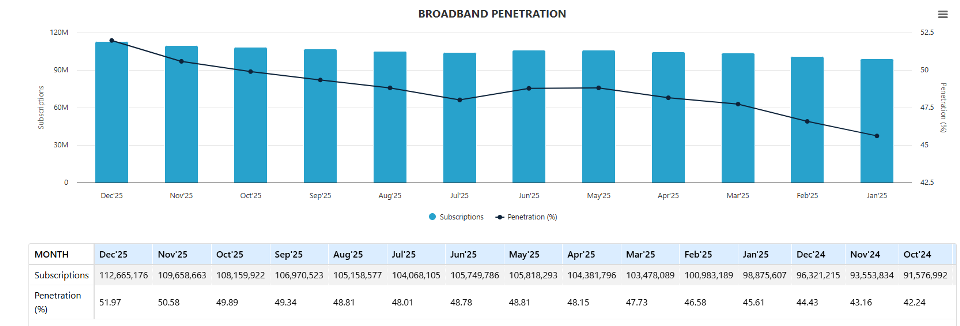
The penetration rate, representing the percentage of the population with broadband access, climbed from 42.2% in October 2024 to just under 52% in December 2025.

Despite subscription increases, penetration growth slowed at mid-year, hovering around 48% from June to August 2025, suggesting that population growth and uneven distribution across regions may be moderating the pace at which Nigerians gain access to high-speed internet.
This growth underscores the role of both infrastructure expansion and policy initiatives in improving internet accessibility.
Mobile broadband remains the dominant contributor to these numbers, as telecom operators continue to expand 4G and 5G coverage nationwide.
However, the data also signals opportunities for further growth, particularly in rural and underserved regions where penetration lags behind the national average.
With Nigeria’s broadband market now firmly above the 50% penetration mark, stakeholders, including policymakers, investors, and tech companies, have a clearer view of the country’s digital readiness.
As more Nigerians come online, opportunities for digital commerce, fintech adoption, and online services are set to expand, making broadband not just a utility but a key enabler of economic growth.