


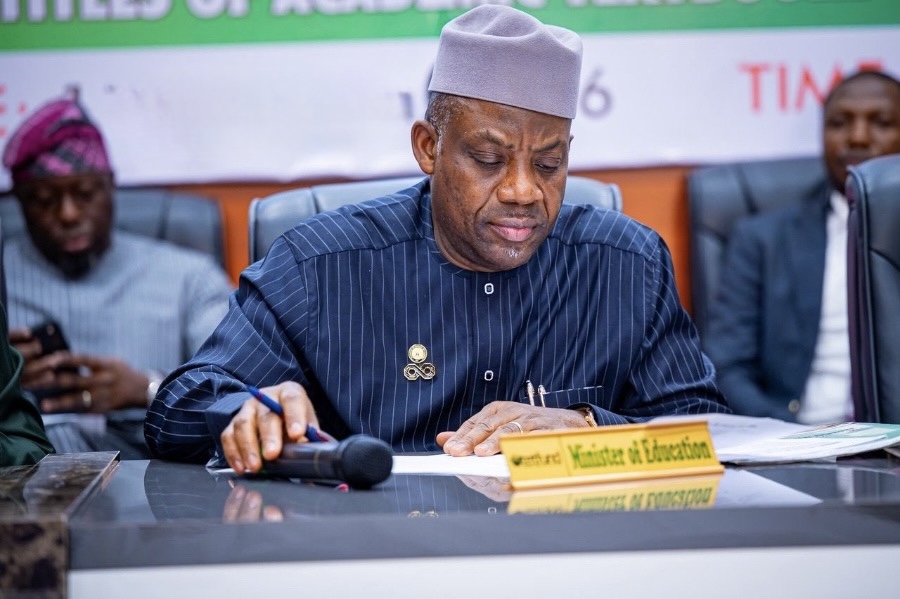
The Federal Ministry of Education has revealed plans to launch its Digital National Education Management Information System (DNEMIS) on July 1, 2026, in a bid to unify education data across the country.
Designed to bring together information on learners, teachers, schools and education funding in one system, the platform has already captured over 32 million students in its database ahead of the rollout.
Mr Adebayo Onigbanjo, national project coordinator at the Special Programmes Operations and Implementation Unit in the Ministry, announced the launch date in Abuja on Monday.
He said DNEMIS is part of the Nigeria Education Data Infrastructure under the Nigeria Education Sector Renewal Initiative. He described it as a central tool for fixing long-standing data gaps in the sector.
Onigbanjo said the education system has struggled for years with scattered records and inconsistent reporting.
“For many years, education planning and administration relied on fragmented systems, inconsistent reporting processes and limited access to reliable and timely data. These challenges constrained effective planning, weakened accountability and limited the sector’s ability to respond to emerging realities,” he said.
He added that the new platform changes how education data will guide decisions.
“Data is no longer a back-office function. It is becoming the engine of education reform in Nigeria,” he added.
The ministry says DNEMIS will standardise how data is collected and used across all levels of education. It will also support planning, budgeting, monitoring and policy decisions in real time.
The system will digitise the Annual School Census, which has long depended on manual and fragmented reporting across states.
Ms Mojoyin Adebajo, special assistant to the Minister on Digital Communications and E-Learning, said the platform will also open access to selected education data through a public portal.
“This represents an important step towards expanding access to information and encouraging broader participation in conversations that shape the future of education in Nigeria,” she said.
She explained that different groups, including researchers, journalists, civil society organisations, development partners and private sector actors, will be able to access official education data through the system.
Officials also confirmed that DNEMIS runs on the District Health Information Software 2 (DHIS2), adapted for education management.
The design will allow the system to track learners from entry into school through to completion and will also help identify dropouts and improve follow-up across the education pathway.
Mr Abubakar Isah, NEDI coordinator, said the platform includes protection to comply with Nigeria’s data protection laws. He said the system was built with security and responsible data use in mind.
Officials also noted the long-term plan is to merge different education databases into one unified system. This includes teacher records and individual learner profiles.
UNICEF has supported parts of the project. Its Education Specialist for Planning, Monitoring, Data and Research, Saka Ibraheem, said integration will continue over the next year.
“Before next year, we hope to have the Education Management Information System, Teacher Management Information System and individual learner records in one system. One system for education and one system for Nigeria,” he said.
He added that the system will assign unique identifiers to learners. This will help track enrolment and movement across schools and reduce the number of out-of-school children.
The launch of DNEMIS will take place just after National Learning Assessment Week, scheduled for 29 June to 3 July 2026.
The Federal Government has said the assessment will cover all 36 states and the Federal Capital Territory and will collect nationwide data on learning outcomes for the first time at this scale.
Again, officials have said the assessment will support planning, policy reforms and resource allocation across the education sector.

Discover more from Tech | Business | Economy
Subscribe to get the latest posts sent to your email.



