


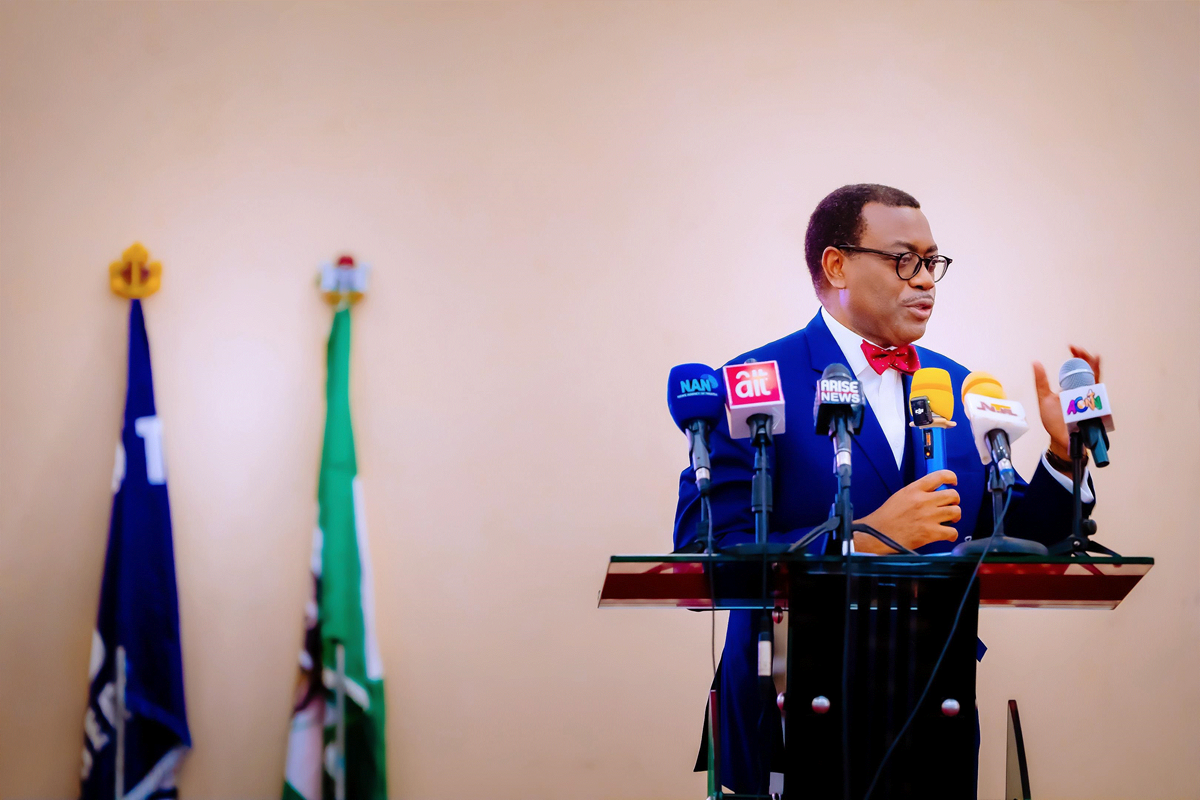
Dr. Akinwumi Adesina, the president of the African Development Bank Group, has said the decision by Nigeria’s government to allow massive food importation risks destroying the country’s agriculture.
This follows the announcement by Nigeria’s Minister for Agriculture Abubakar Kyari on July 10 that the Federal Government would suspend duties, tariffs, and taxes on the importation of maize, husked brown rice, wheat, and cowpeas through the country’s land and sea borders, for 150 days.
“Nigeria’s recently announced policy to open its borders for massive food imports, just to tackle short-term food price hikes, is depressing,” Adesina told African Primates of the Anglican Church at a Retreat in Abuja, Nigeria, on Friday.
He warned that the policy could undermine all the hard work and private investments that have gone into Nigeria’s agriculture sector.
“Nigeria cannot rely on the importation of food to stabilize prices. Nigeria should be producing more food to stabilize food prices, while creating jobs and reducing foreign exchange spending, that will further help stabilize the Naira,” said the African Development Bank president.
“Nigeria cannot import its way out of food insecurity,” he said, “Nigeria must not be turned into a food import-dependent nation.”
Speaking on the theme ‘Food security and financial sustainability in Africa: The role of the Church’, Adesina said Nigeria “must feed itself with pride,” warning, “a nation that depends on others to feed itself, is independent only in name.”
Faith and food security
The clergymen assembled in Abuja under the umbrella of the Council of Anglican Provinces of Africa (CAPA), representing more than 40 million Anglicans across the continent.
In his opening remarks, the host, His Grace the Most Reverend Henry C. Ndukuba, Primate of the Church of Nigeria (Anglican Communion), said the gathering was a unique opportunity for African Anglican leaders to deepen bonds of friendship and collaboration, and to share collective wisdom and experiences.
The chairperson of the event, Emeritus Nigerian Professor of Science Education, Olugbemiro Jegede, told Adesina: “You have the whole of Africa represented here. Every Primate represents a region. Behind these Primates are millions and millions of Anglicans who are listening to us here.”
Noting that Africa accounts for nearly a third of the more than 780 million people worldwide who are hungry, the African Development Bank president said agriculture is critical for the diversification of economies, and for the transformation of rural areas, where over 70 percent of the population of Africa live.
“It is clear therefore that unless we transform agriculture, Africa cannot eliminate poverty,” he insisted.
Adesina said Africa has 65 percent of the uncultivated arable land left in the world, to feed 9.5 billion people by 2050. Therefore, what Africa does with agriculture will determine the future of food in the world. “Essentially, food is money. The size of the food and agriculture market in Africa will reach $1 trillion by 2030.”
Transformational strides
Adesina briefed the Primates on the Bank’s $25 billion program to transform agriculture by providing high performing agricultural technologies for 40 million farmers and making Africa food self-sufficient by 2030.
He shared the Bank’s successes in helping member countries tackle the negative effects of climate change, through financial investments and its flagship Technologies for African Agricultural Transformation (TAAT) program.
According to the Bank president, TAAT has helped Ethiopia to become a net exporter of wheat within five years, and it has significantly increased Sudan’s wheat production, as well as supported countries in Eastern and Southern Africa to continue producing food in the face of a prolonged drought.
For Nigeria, Adesina said,
“Together with the Islamic Development Bank and the International Fund for Agricultural Development, we have provided $520 million to support the establishment of Special Agricultural Processing Zones, which will allow private agribusinesses to establish industries that process and add value to agricultural commodities.”
In addition, the Bank provided $134 million to Nigeria for emergency food production to help drive down food price inflation, by significantly boosting the local production of wheat, and cassava, under the national Agricultural Growth Scheme.
Adesina urged the Nigerian government to take advantage of the Bank’s investments and support for African farmers; show greater determination and commitment to achieving food self-sufficiency, and to incentivize private sector agribusinesses.
To support Africa’s ambitions to move up the global agricultural value chains, the African Development Bank Group and its partners, are supporting the development of 28 Special Agro-Industrial Processing Zones (SAPZs) l in 11 countries, with $4.5 billion dollars mobilized so far.
Speaking on behalf of the Chairman of the Council of Anglican Provinces of Africa and Bishop of Northern Zambia, the Most Reverend Albert Chama, the Archbishop of the Anglican Church of Kenya, the Most Reverend Dr. Jackson Ole Sapit, called for greater cooperation between the Bank Group and the Anglican Church.
“The African mind must be at the center of solving African problems. If the African Development Bank mobilizes resources for the African continent, and the Church also mobilizes resources for holistic transformation, we can achieve a lot working together – and make a difference,” Ole Sapit said.
The church as a change agent
Proposing solutions for agriculture in Africa, Adesina said the world desperately needs “visionary and passionate leaders who are strategic solution providers and transformational change makers.”
This includes, he said, public advocacy for robust government policies to end hunger and malnutrition, complemented by church-led food banks and other social protection programs for the poor and needy; investing in commercial farms, especially in rural areas; advocacy on issues of climate change; supporting and encouraging young Africans to engage in agricultural entrepreneurship; and demanding greater financial accountability, public probity, and better financial management from governments.



