


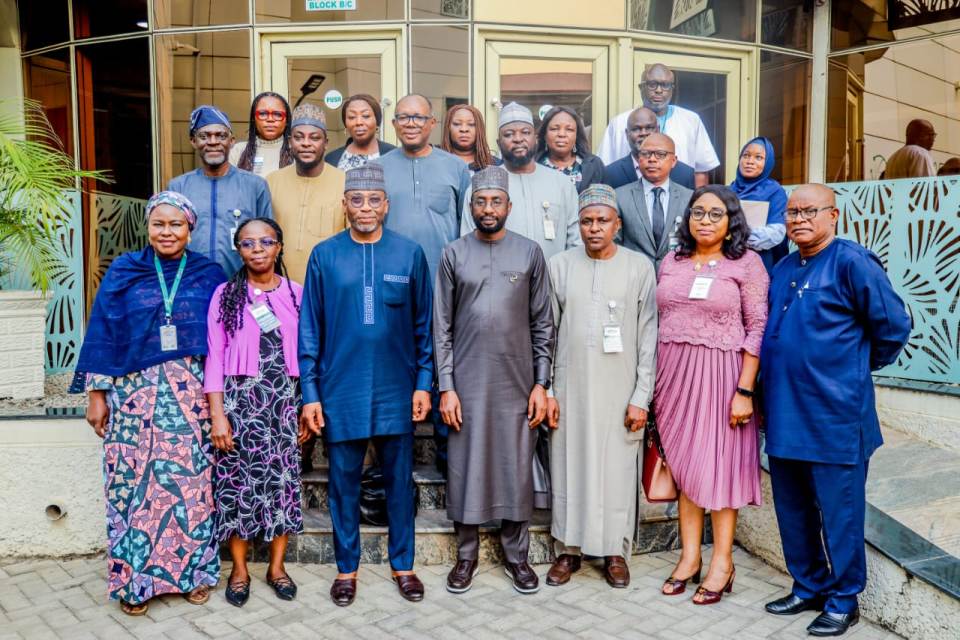
When the leadership of the National Broadcasting Commission (NBC) paid a courtesy visit to the National Information Technology Development Agency (NITDA), the conversation quickly moved beyond formalities.
At the centre of the meeting was a shared realisation: in today’s Nigeria, digital transformation and media regulation can no longer travel separate paths.
Receiving , Mr. Charles Ebuebu, the NBC director general, Kashifu Inuwa, NITDA’s director general, spoke candidly about what it truly takes to build a modern digital public sector in an ecosystem where technology, content, and regulation increasingly overlap.
For Inuwa, digital transformation is not a destination, it is a journey. One that demands constant learning, periodic reassessment, and the courage to rethink long-standing ways of working.
“Digital transformation is continuous,” he explained. “It requires adaptability, clear targets, and the willingness to evolve as realities change.”
Changing Mindsets Before Changing Systems
Inuwa traced NITDA’s transformation story back to a critical starting point: people. When the agency began its reform journey, the majority of its workforce had migrated from the mainstream civil service, bringing with them deeply entrenched bureaucratic habits and rigid operational structures.
Rather than ignore this reality, NITDA confronted it head-on.
“Over 70 to 80 per cent of our staff came from the traditional public service,” Inuwa noted. “We understood the mindset, so we deliberately changed the narrative, by focusing on people, resetting attitudes, building capacity, and creating a culture that supports innovation and accountability.”
This people-first approach, he explained, became the foundation upon which every other reform rested.
Culture as the Engine of Transformation
At NITDA, culture was not treated as a soft issue. It became a strategic tool. The agency embarked on a comprehensive cultural reorientation, supported by internal audits and initiatives designed to foster psychological safety, an environment where staff could question processes, propose ideas, and collaborate across hierarchies without fear.
According to Inuwa, this shift was essential.
“No matter how sound a strategy may be, without the right culture, execution will fail,” he said.
The agency adopted an integrated framework covering people, process, culture, content, and technology. Through this lens, long-standing bureaucratic traits, command-and-control leadership, risk aversion, and excessive dependence on top-level approvals, were systematically identified and dismantled.

Rebuilding Processes for Speed and Trust
One of the most striking outcomes of this transformation was process reform. NITDA documented over 396 internal processes, many of which were weighed down by inefficiencies and redundant approvals.
These were streamlined to empower departments, encourage trust-based delegation, and free leadership to focus on strategy rather than routine administration.
Tasks that once required multiple approvals at the Director General’s desk were redesigned so departments became accountable gatekeepers, creating room for automation and smarter digital workflows.
AI as an Enabler, Not a Threat
On technology adoption, Inuwa made NITDA’s position clear: technology must serve purpose, not hype. Every staff member underwent mandatory artificial intelligence training, reinforcing the agency’s belief that AI is a productivity enabler, not a job replacer.
Today, staff across departments are using AI to enhance workflows, generate insights, and move from manual administrative roles into AI-enabled system management, proof that technology, when properly aligned with people and processes, can unlock real value.
This experience, Inuwa revealed, has been carefully documented in a digital transformation playbook, one the agency is willing to share with NBC and other government institutions.
A New Chapter of Inter-Agency Collaboration
Looking ahead, Inuwa proposed concrete areas for collaboration between NITDA and NBC, including shared access to the transformation playbook, tailored capacity-building programmes, digital literacy initiatives delivered with global partners such as Cisco, and technical support to modernise regulatory frameworks for Nigeria’s evolving media and digital ecosystem.
For NBC’s Director General, the meeting affirmed what he described as a long-overdue partnership.
Mr. Ebuebu noted that while he had engaged the NITDA DG informally in the past, institutionalising collaboration was now critical, given the rapid convergence of media, technology, data governance, and content distribution.
According to him, a strategic partnership between NBC and NITDA is essential, not only to regulate the modern media landscape effectively, but also to support local content growth, promote innovation, enable knowledge transfer, and safeguard Nigeria’s cultural and national interests.
As Nigeria’s digital economy expands, the meeting signalled a clear message: the future of digital transformation will be built not in silos, but through collaboration, where technology, regulation, and culture evolve together.