


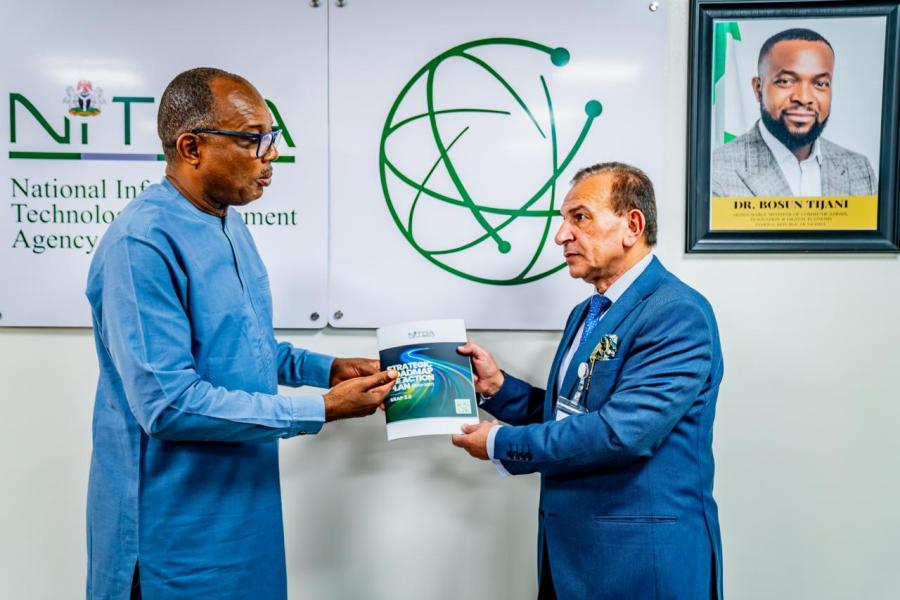
The National Information Technology Development Agency (NITDA) and Wigwe University are exploring a strategic collaboration focused on artificial intelligence (AI) research, smart agriculture and digital talent development, following a high-level meeting in Abuja.
The engagement, led by Professor Marwan Al Akaidi, Wigwe University vice chancellor, and senior NITDA officials, highlighted alignment between the university’s academic ambitions and the agency’s national technology mandate.
Plan to build Nigerian AI
Professor Al Akaidi said Wigwe University, founded under the vision of the late Herbert Wigwe, was established to become the university of Africa, delivering high-quality teaching and transformative research across the continent.
He noted that while Nigeria is rich in talent, it often lacks the platforms and structured opportunities to harness that potential effectively.
Drawing on his academic experience in the United Kingdom and the Middle East, the Vice Chancellor disclosed that the university is already running AI for Health research in Nigeria with a team of 10 researchers.
He revealed plans to establish a full-scale AI centre in Nigeria, similar to one he helped set up in Abu Dhabi.
Although funding challenges followed Herbert Wigwe’s passing, he said the ambition remains intact.
According to him, the university’s goal is not to rely solely on foreign AI tools but to develop a locally driven, world-class AI system tailored to Nigeria’s languages, realities and development needs.
AI-driven agriculture and healthcare
Professor Al Akaidi also pointed to the university’s location in Rivers State as a strategic advantage for agricultural innovation.
He said the institution is positioned to apply AI solutions to livestock management, land use optimisation, food processing and agricultural productivity.
Using Nigeria’s large cattle population as an example, he argued that improved feeding systems and AI-enabled monitoring could significantly raise output levels.
He added that AI applications in healthcare, particularly in diagnosis and management of diseases such as malaria, could improve service delivery and outcomes across hospitals.
Alignment with NITDA’s mandate
NITDA’s representative, Dr. Aristotle, described the agency as Nigeria’s technology powerhouse, with responsibilities spanning IT regulation, innovation, research and standards.
He said Wigwe University’s proposals align with NITDA’s strategic priorities, including initiatives under the National Centre for Artificial Intelligence and Robotics and the National Adopted Village for Smart Agriculture programme.

According to him, collaboration with academia remains central to building a sustainable national technology ecosystem.
He added that NITDA’s Strategic Roadmap and Action Plan is anchored on pillars such as knowledge development, research and innovation, entrepreneurship and partnership.
“Whatever we commit to, we will do,” he said, stressing that no single institution can drive national transformation alone.
Research ecosystem and digital literacy push
NITDA’s Director of Research and Development, Dr. Kumo, said the agency is working to position Nigeria among the top 25% of countries globally in research performance.
He noted that Wigwe University’s focus areas, including AI, robotics, unmanned aerial vehicles (UAVs), Internet of Things (IoT), blockchain and additive manufacturing, mirror the agency’s research priorities.
He also emphasised the importance of virtualising education to allow learners across Nigeria to access programmes remotely, thereby expanding inclusivity.
From NITDA’s Digital Literacy and Capacity Building Department, Dr. Tambuwal highlighted the agency’s efforts to build a digitally skilled population from foundational to tertiary levels.
He noted that many workers still lack the digital competence required to operate modern systems efficiently, underscoring the need for universities to produce job-ready, digitally fluent graduates.
Focus on industry-ready graduates
Professor Al Akaidi stressed the need for stronger alignment between academia and industry, particularly in computing and engineering disciplines.
He said curricula must be continuously updated to reflect current realities, adding that education should be underpinned by active research.
According to him, Wigwe University is deliberately fostering a culture of innovation and entrepreneurship, with students encouraged to become job creators rather than job seekers.
He disclosed that second-year students at the institution are already preparing to launch a major educational application, demonstrating the capacity of young Nigerians when adequately supported.
Next steps
Both institutions agreed to identify dedicated contact teams and develop specific workstreams covering AI research, smart agriculture, digital literacy, virtual learning and emerging technologies.
If implemented, the partnership could strengthen Nigeria’s research ecosystem and accelerate the country’s push toward technology-driven economic growth.