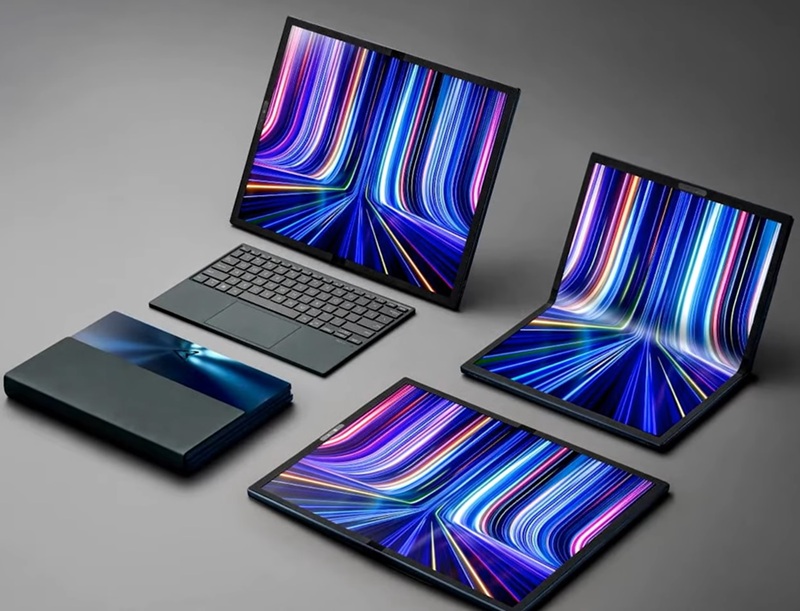
The global market for Organic Light Emitting Diode (OLED) notebook displays is on a high-growth trajectory, projected to reach $11.5 billion by 2033.
This massive transformation represents an aggressive hardware migration, as original equipment manufacturers (OEMs) phase out legacy Liquid Crystal Displays (LCDs) in favor of premium display architectures to capture high-margin segments.
According to a comprehensive sector forecast by global market research and advisory firm Omdia, this ten-year structural shift is being supercharged by two main catalysts: rapid hardware efficiency gains and the massive ecosystem roll-out of AI-enabled personal computers (AI PCs).
The Architecture Shift: Why LCD is losing Ground
For years, LCD panels dominated the mobile computing landscape due to mature supply chains and low production costs. However, as form factors shrink and compute loads increase, display performance has become a major product differentiator.
OLED panel technology offers fundamental engineering advantages over conventional backlit LCD systems:
- Per-Pixel Illumination: Eliminates traditional backlighting, allowing for true blacks and deep contrast ratios.
- Energy Draw: Lower power consumption on darker user interfaces, directly extending battery runtime.
- Response Velocity: Significantly faster pixel response times, making them highly attractive for high-end enterprise computing, gaming, and creative workloads.
The Ecosystem View: Omdia’s data identifies mobile PC displays (notebooks, tablets, and specialized monitors) as one of the fastest-growing verticals within the broader display ecosystem. The firm projects OLED demand across mobile PCs to sustain a compound annual growth rate (CAGR) of approximately 34% over the forecast window.
Supply Chain Dynamics and the Rise of Tandem OLED
To capitalize on this shifting demand, tier-one display suppliers are aggressively restructuring their capital expenditure. Manufacturers are actively commissioning next-generation fabrication lines capable of processing larger substrate sizes, specifically optimized for notebook-sized form factors.
| Technology Dimension | Legacy LCD Panels | Next-Gen Tandem OLED Panels |
| Illumination Source | Constant LED Backlight | Self-emitting Organic Pixels (Dual-Stack) |
| Contrast & Accuracy | Limited by local dimming zones | Infinite contrast; true black capability |
| Peak Brightness & Lifespan | High brightness; long lifespan | Doubled brightness; extended panel lifespan |
| Primary Target Market | Budget to Mid-tier enterprise | Premium consumer, AI PCs, & Creators |
A major sub-trend reinforcing this $11.5 billion valuation is the rapid industrialization of Tandem OLED technology.
By stacking two layers of organic light-emitting material instead of one, tandem displays effectively double peak brightness while significantly extending the operational lifespan of the panel.
Macro Implications for Emerging Tech Hubs
For tech-driven economies and regional consumer markets like Nigeria, this technological transition will directly impact device procurement cycles, local enterprise device lifecycle management, and the pricing structures of incoming hardware.
As premium tech brands establish OLED as the baseline configuration for AI-capable laptops, older LCD-equipped models are expected to trickle down into entry-level tiers.
This shift will create clear cost-performance choices for local enterprises looking to optimize their corporate IT infrastructure over the next decade.