The numbers that define Nigeria’s telecommunications sector in the first quarter of 2026 tell a story of recovery, scale, and strategic importance, and they deserve to be read carefully.
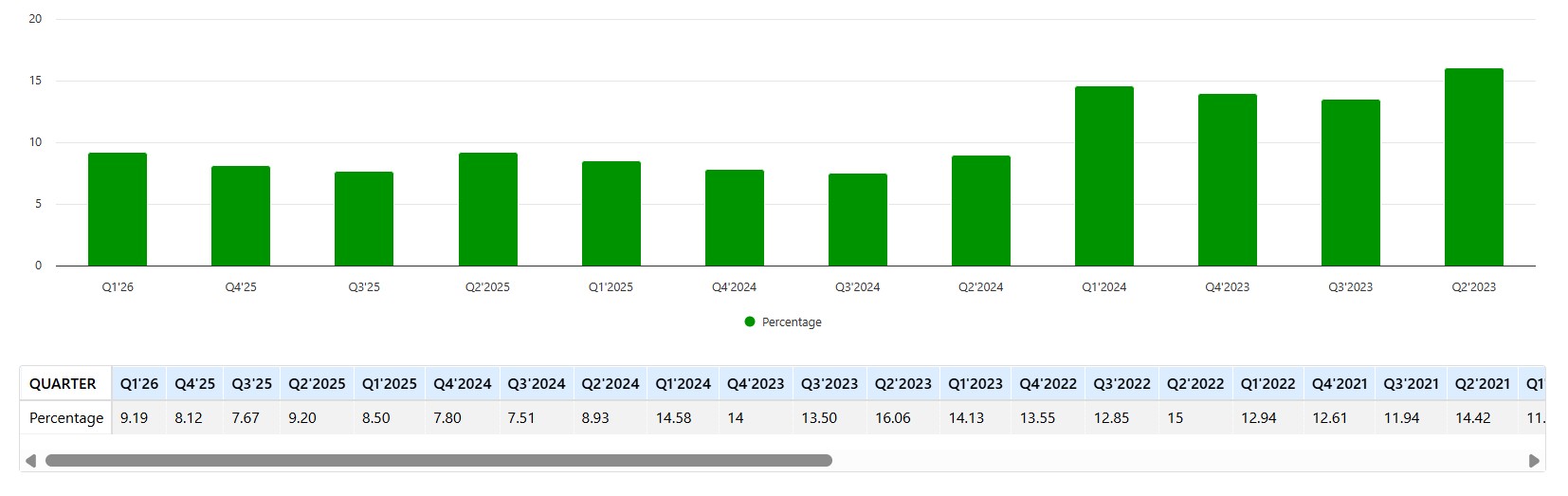
Nigeria’s telecommunications industry contributed 9.19 per cent, equivalent to ₦4.71 trillion, to the country’s real GDP in the first quarter of 2026, according to the latest economic data released by the National Bureau of Statistics.
The figure marks a decisive rebound from the sector’s performance through much of 2025 and confirms that telecommunications has re-established itself as one of the most consequential engines of Nigeria’s non-oil economy.
The trajectory in the chart data is instructive. After the sector’s GDP contribution dipped to 7.67 per cent in Q3 2025, it climbed steadily, to 8.12 per cent in Q4 2025, before accelerating to 9.19 per cent in Q1 2026.
The 9.19 per cent contribution is the telecoms industry’s second-highest quarterly share of Nigeria’s real GDP over the past eight quarters, building on the 8.12 per cent recorded in Q4 2025 and the 7.67 per cent in Q3 2025.
Source: NCC
Compared directly with Q1 2025, when the sector contributed 8.50 per cent to real GDP, the Q1 2026 figure of 9.19 per cent represents a 69 basis point improvement year-on-year, a rebound that reflects both rising subscriber volumes and the accelerating monetisation of data consumption across Nigeria’s digital economy.
Data spending: the number beneath the headline
Industry data from the Nigerian Communications Commission (NCC) reveal that Nigerians spent ₦3.33 trillion on internet data in the first three months of 2026, with an average Nigerian internet subscriber consuming 4.06 million terabytes in the quarter, equivalent to approximately 28 gigabytes per subscriber.
The data spending figure is striking in its own right. ₦3.33 trillion on data in a single quarter, from a subscriber base that was still largely on 3G and 4G networks for most of that period, speaks to a structural shift in how Nigerians consume information, conduct business, and access services.
At that annualised run rate, Nigerian data spending would approach ₦13 trillion for the full year, a figure that places digital connectivity spending among the most significant consumer expenditure categories in the country.
Subscribers, coverage, and the 5G acceleration
The subscriber data behind the GDP numbers reflects an industry in genuine expansion. Active mobile lines rose to 182.2 million as of January 2026, up from 169.3 million in January 2025, a gain of approximately 13 million new subscriptions over twelve months. Teledensity improved to 84.06 per cent from 78.10 per cent a year earlier, reflecting the broadening reach of mobile services across the population.
Internet subscriptions rose to 151.6 million in January 2026, compared to 141.7 million a year earlier, while total data consumption reached 1,385,536 terabytes, up sharply from 1,000,930 terabytes recorded in the same period of 2025.
The 5G story adds another layer of forward momentum. The percentage of subscribers on 5G networks rose from 2.46 per cent in December 2024 to 3.77 per cent by December 2025, with Q1 2026 showing further acceleration to 4.20 per cent.
While still a small share of the overall subscriber base, the acceleration in 5G adoption is consistent with the infrastructure investment commitments that MTN, Airtel, and other operators have made in the network expansion programme acknowledged by the NCC’s 109th Board meeting communiqué in May 2026.
Operator performance validates the macro picture
The sector-level GDP data is corroborated by individual operator results. Airtel Nigeria’s earnings for Q1 2026 surged 40.2 per cent to $475 million, with nearly half of that revenue, $244 million, attributable to data subscriptions.
MTN Nigeria’s data revenue for the period reached ₦826.1 billion, contributing to a profit before tax of ₦546.4 billion.
Nigeria’s nominal GDP for Q4 2025 rose to ₦122.81 trillion, up 17.55 per cent year-on-year, and telecommunications closed the 2025 financial year with a real growth rate of 26.34 per cent year-on-year in Q4, recording the highest nominal quarterly contribution of the year at ₦5.2 trillion. The Q1 2026 rebound in percentage-of-GDP terms builds directly on that Q4 2025 momentum.
The fourth-largest contributor, and what that means
Telecommunications is the fourth-largest contributor to Nigeria’s real GDP, behind only crop production at 20.44 per cent, trade at 16.84 per cent, and real estate at 14.57 per cent. In the non-oil, non-agricultural context that defines Nigeria’s structural economic reform agenda, that positioning is extraordinary.
A sector that did not exist in its current form twenty-five years ago now contributes more to Nigeria’s measured economic output than manufacturing, construction, or financial services individually.
Telecoms is the heart of the economy as banking, fintech, e-commerce, education, and health mostly depend on connectivity for daily operation. It will play a significant role in Nigeria’s $1 trillion digital economy ambition.
The infrastructure constraint that the rebound does not mask
The Q1 2026 GDP figures are genuinely encouraging. But they coexist with a persistent infrastructure vulnerability that the sector’s own data documents with uncomfortable specificity.
Between January and August 2025, Nigeria recorded 19,384 fibre-optic cable cuts, 3,241 cases of equipment theft, and more than 19,000 denials of access to telecom sites.
In Q1 2026 alone, a further 5,934 fibre cuts were recorded, with operators reporting an average of 30 to 43 daily fibre cuts across the country.
MTN Nigeria alone suffered 9,218 fibre cuts throughout 2025, generating 1.6 million customer complaints as a direct consequence. Every fibre cut translates into service disruptions, emergency repair costs, productivity losses for connected businesses, and a deterrent signal to further infrastructure investment.
The NCC’s data on infrastructure vandalism sits in direct tension with the GDP contribution figures. The sector is growing at rates that reflect genuine demand-side momentum. But the supply-side infrastructure it depends on is being damaged faster than enforcement action has been able to contain.
The NCC estimates that a 10 per cent increase in broadband penetration drives approximately 1.38 per cent GDP growth in developing economies, a multiplier that makes every infrastructure cut not merely an operational problem but a measurable drag on Nigeria’s economic output.
As discussed above…
Nigeria’s telecoms sector entered 2026 with a rebound that the data validates at every level, GDP contribution, subscriber growth, data consumption, operator revenue, and 5G acceleration.
The 9.19 per cent GDP share in Q1 2026, set against 8.50 per cent in Q1 2025, is not a statistical blip. It is the output of sustained investment, rising demand, and an industry that has found durable growth even through a period of significant macroeconomic turbulence.
The challenge the rebound presents is a productive one: a sector of this strategic importance, growing at this pace, requires infrastructure protection and regulatory modernisation at equivalent pace.
The GDP contribution figure tells what the sector has achieved. The fibre cut numbers tell what is still at risk.
Both sets of numbers deserve the same level of national policy attention.
[Data sources: National Bureau of Statistics, Nigerian Communications Commission, MTN Nigeria Q1 2026 results, Airtel Africa Q1 2026 results].