



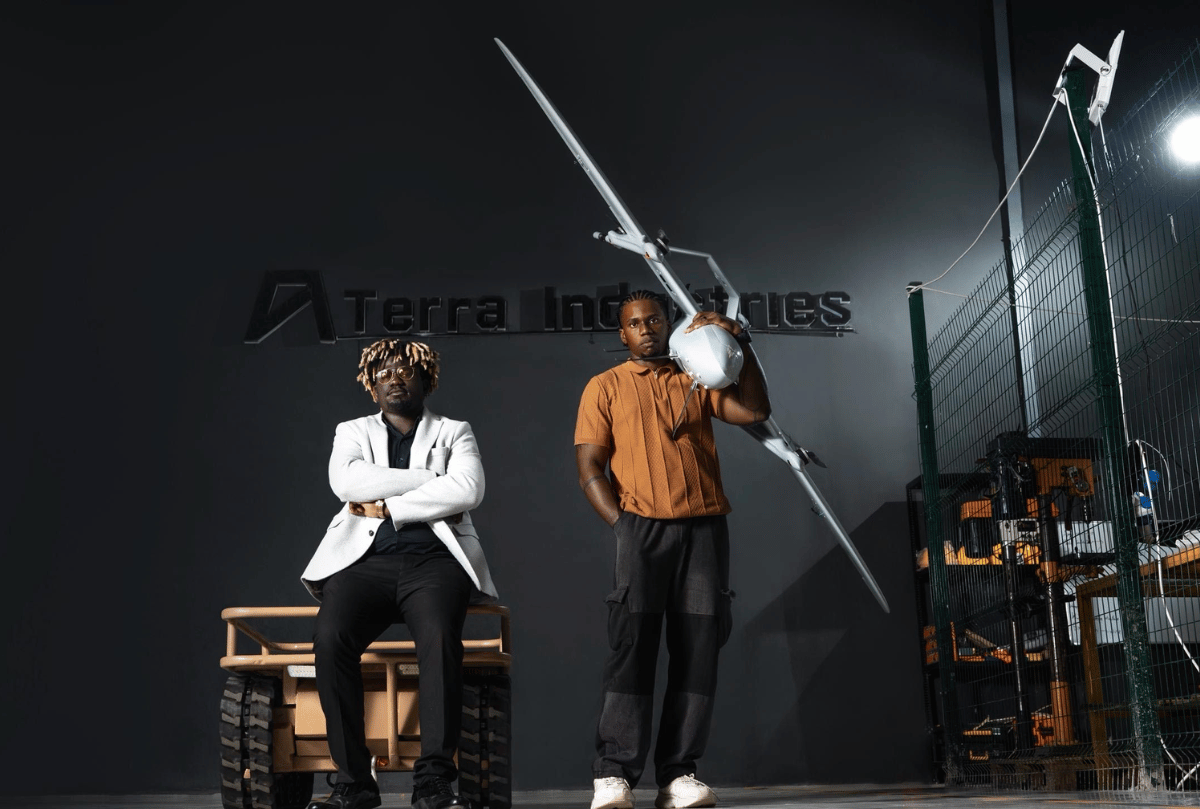
Terra Industries has raised an additional $22 million in funding, just one month after closing an $11.75 million round.
The new investment was led by Lux Capital and brings the Nigerian defence technology company’s total funding to $34 million since it launched in 2024.
The extension round also drew participation from 8VC, Nova Global, and Resiliience17 Capital, a firm founded by Flutterwave chief executive Olugbenga Agboola.
Terra Industries was founded by Nathan Nwachuku, 22, and Maxwell Maduka, 24. The company designs infrastructure and autonomous systems that help governments monitor and respond to security threats.
Based in Nigeria, the startup has begun expanding into other African countries, though it has not yet named them.
Terrorism is a major threat across parts of Africa. Many countries still depend on intelligence and defence systems supplied by Russia, China or Western nations.
In January, Nwachuku said he wanted to build “Africa’s first defence prime, to build autonomous defence systems and other systems to protect our critical infrastructure and resources from armed attacks.”

At that time, Terra had secured its first federal contract. The company now serves both government and commercial clients. Nwachuku said Terra has generated more than $2.5 million in commercial revenue and is protecting assets valued at about $11 billion.
He said the latest funding came together in under two weeks because of “strong momentum.” Investors, he added, saw “faster-than-expected traction” in new deals and partnerships, which pushed them to increase their commitments quickly.
Part of that growth includes a contract with AIC Steel. The agreement allows Terra to set up a joint manufacturing facility in Saudi Arabia to build surveillance infrastructure and security systems. “It’s our first major manufacturing expansion outside Africa,” Nwachuku said.
The company is now focusing on countries in sub-Saharan Africa and the Sahel, where infrastructure security remains a pressing issue. “The priority is working with countries where terrorism and infrastructure security are major national concerns,” he said.
He also pointed to the scale of the problem. “We’re focused on targeting major economies where the need for infrastructure security is urgent and where our solutions can make a meaningful impact. That’s how we think about expansion.”
Defence technology is capital-intensive. In the United States, companies such as Anduril Industries have raised more than $2.5 billion, while Shield AI has secured around $1 billion in equity funding.
Drone maker Skydio has raised about $740 million, and naval autonomous vessel company Saronic has secured roughly $830 million.
Terra Industries funding is smaller by comparison. Even so, its rapid fundraising and early contracts imply that investors are getting more interested in defence innovation on the continent.