


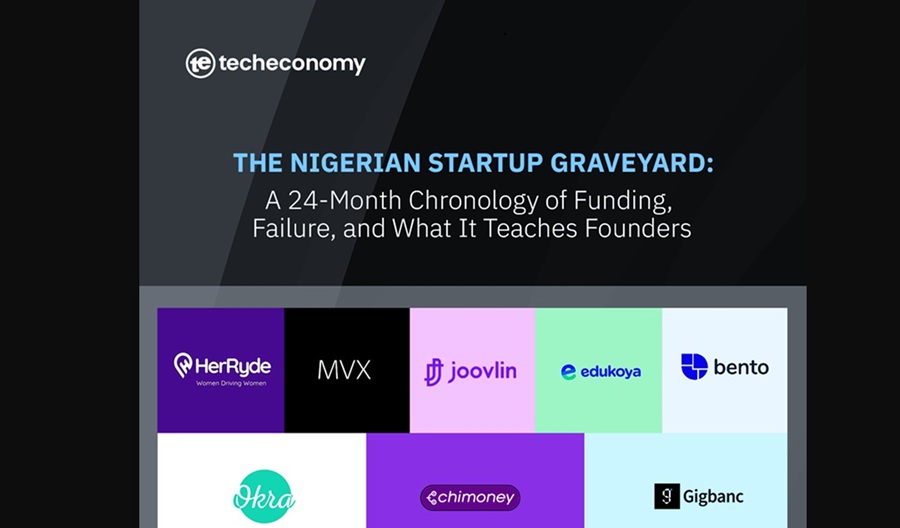
When Gigbanc‘s co-founders sat down to write their farewell letter, they described the decision to shut down as one of the hardest of their careers. But in Nigeria’s tech ecosystem, that letter now joins a growing, painfully consistent startup graveyard.
Over the past two years, at least half a dozen Nigerian startups, spanning fintech, edtech, HR tech and mobility, have written some version of the same letter.
Laid end to end, their stories trace a shift in the reasons startups die: from a simple funding drought, to naira-driven cost shocks, to governance collapses, to a 2026 funding climate that founders and investors alike now describe as one of the toughest in the ecosystem’s history.
Here is that chronology, and what each closure reveals about Nigeria’s startup graveyard.
May 2024 – HerRyde
A women-focused ride-hailing platform aiming to provide safer transport and job opportunities for female drivers, HerRyde hibernated after failing to secure follow-on funding.
Its board said it was re-strategising while seeking investors for a possible relaunch, a pattern that would recur across the ecosystem: not a formal shutdown, but an indefinite pause with no confirmed return.
November 2024 – MVX
Founded in 2019 to digitise cargo tracking and marketplace logistics for Nigerian shipping, MVX raised $1.4 million and expanded across Africa before its website was quietly put up for sale. Naira depreciation and unpredictable Nigerian Customs Service policy shifts made its logistics-financing model untenable.
January 2025 – Joovlin
A B2B commerce platform for micro-suppliers and retailers, Joovlin shut down after nearly four years, despite reaching over 2,000 active resellers and 6,000 listed products.
The company’s own account of its failure was blunt: it could not raise further capital, and low revenue gave it no cushion, while stiff competition meant customers had little loyalty to any single platform.
February 2025 – Edukoya
Having raised what was then Africa’s largest edtech pre-seed round ($3.5 million, December 2021), Edukoya shut down after nearly three years, citing limited market readiness, poor connectivity, low device access and constrained household income among the students it hoped to serve. Notably, Edukoya returned capital to its investors before closing, a comparatively rare, responsible exit in this chronology.
February 2025 – Bento Africa
Unlike the funding-driven closures above, Bento’s collapse was a governance failure. The HR and payroll startup faced allegations of tax and pension remittance fraud, triggering investigations by the Lagos State Inland Revenue Service and the EFCC.
CEO Ebun Okubanjo resigned, the entire engineering team was let go amid unpaid-salary disputes, and major clients, including Moniepoint and Paystack, terminated their contracts. Bento is the clearest reminder in this list that not every shutdown is a funding story.
July 2025 – Okra
Perhaps the highest-profile closure in the group. Backed by $16.5 million and once seen as Africa’s answer to Plaid, Okra built open banking infrastructure connecting Nigerian bank accounts to third-party apps.
Its downfall was a currency story: naira devaluation made its USD-denominated cloud infrastructure costs prohibitive, and a late pivot to an in-house, naira-priced cloud alternative (Nebula) collapsed once AWS began offering local-currency billing of its own.
May 2026 – Chimoney
A cross-border payments API startup founded in 2022, Chimoney ceased transactions on May 1, 2026, after a pivot toward AI-agent payments failed to attract enough customers before capital ran out.
Founder Uchi Uchibeke’s own diagnosis was candid: “Under $1 million is too thin for a venture-scale fintech across multiple jurisdictions… Trying to operate at venture scale on bootstrap capital was the wrong strategy.”
July 2026 – Gigbanc
Which brings the chronology to Gigbanc, a neobank that grew to 150,000+ users and ₦10 billion-plus in processed volume, reportedly on under $300,000 in disclosed pre-seed capital. Its founders framed the closure explicitly around “the broader funding environment affecting early-stage startups in Africa.”
The pattern underneath the pattern
Read individually, each of these is a distinct story, a currency shock, a failed pivot, a fraud scandal, a stalled fundraise.
Read together, they trace a shift in the ecosystem’s center of gravity. Startup Graveyard Africa has tracked 29 African startup shutdowns between 2023 and 2025, with fintech accounting for the largest single share at 24%.
Nigerian startup funding fell from $976 million in 2022 to $399 million in 2023, a collapse from which the ecosystem has not recovered, and by early 2026, investor participation in African startup deals had fallen a further 26% year-on-year, according to Africa: The Big Deal.
What’s changed is which failure mode dominates. The 2023–2024 wave (HerRyde, Joovlin, Buycoins Pro) reads mostly as a straightforward funding winter: good products, real traction, no follow-on capital.
By 2025, a second layer emerged, macroeconomic shocks (Okra’s naira-driven infrastructure costs) and governance failures (Bento) that funding alone would not have fixed.
By 2026, the Chimoney and Gigbanc cases suggest a third phase: startups that scaled meaningfully on genuinely thin capital, reaching real users and real transaction volume, only to discover that the amount of capital needed to convert traction into a durable business has risen faster than early-stage African fintechs can raise it.
Why this should matter beyond the companies involved
The uncomfortable lesson embedded in this chronology is not that African founders build bad products, several of these companies had real users, real revenue, and real social value (HerRyde’s safety mission, Edukoya’s 80,000 students, Gigbanc’s 150,000 freelancers).
The lesson is that Nigeria’s startup ecosystem has not solved the middle of the funding pipeline: pre-seed and seed capital remains available in small amounts, but the Series A-and-beyond capital needed to convert early traction into sustainable scale has become scarce, expensive, or simply unavailable, leaving founders to either burn out chasing a raise that never comes, or wind down responsibly, as Edukoya and Gigbanc’s founders both chose to do.
For founders building today, the throughline across all seven cases is the same: traction is not a substitute for a funded runway, and currency exposure, governance discipline, and realistic capital-to-scale ratios matter as much as product-market fit.
For investors and policymakers, the question this chronology poses is sharper: if Nigeria continues to produce founders capable of building genuine user bases on minimal capital, what does it say about the ecosystem that so few of them can convert that into their next round?
Your comment is welcome: Which of the startups dissappinted you most by their exit from the market?



