



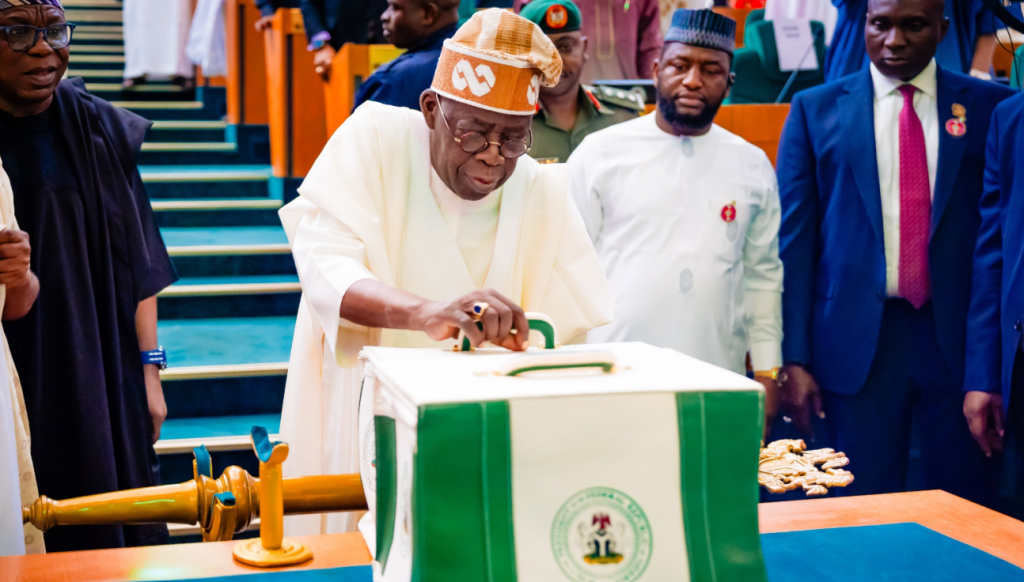
President Bola Ahmed Tinubu on Friday presented the 2026 Appropriation Bill, a ₦58.18 trillion federal budget, to a joint session of the National Assembly, outlining the government’s spending priorities and economic strategy for the coming year.
The plan, themed “Budget of Consolidation, Renewed Resilience and Shared Prosperity,” reflects a shift from economic adjustment toward focused growth and stability.
Top-Line Numbers & Fiscal Framework
- Total expenditure: ₦58.18 trillion
- Projected revenue: ₦34.33 trillion
- Debt servicing: ₦15.52 trillion
- Capital expenditure: ₦26.08 trillion
- Recurrent (non-debt) spending: ₦15.25 trillion
- Budget deficit: ₦23.85 trillion (≈ 4.28 % of GDP)
The budget is based on conservative macroeconomic assumptions, including a crude oil price benchmark of US$64.85 per barrel, daily production of 1.84 million barrels, and an exchange rate of ₦1,400 to the US dollar for 2026.
Priority Sectors & Key Allocations
President Tinubu emphasised that the budget is not merely a financial document but a statement of national priorities:
- Security & Defence – ₦5.41 trillion: The largest single allocation, underscoring the administration’s belief that security is the bedrock of development. Funding is aimed at modernising the Armed Forces, expanding intelligence-driven policing, strengthening border security and supporting a new national counter-terrorism doctrine.
- Infrastructure – ₦3.56 trillion: Support for transport networks, energy projects and other critical public works designed to unlock economic opportunities and attract private investment.
- Education – ₦3.52 trillion: A commitment to human capital development, including support through the Nigerian Education Loan Fund, which has already benefited hundreds of thousands of students.
- Health – ₦2.48 trillion: Representing roughly six percent of the total budget (net of liabilities), this funding seeks to strengthen Nigeria’s healthcare system and expand access to essential services.
Beyond these headline figures, the budget also allocates resources toward enhancing agricultural productivity and economic resilience, including mechanisation, irrigation, storage and agro-value chain development.
Subscribe to our Telegram channel for the latest updates.
Follow the latest developments with instant alerts on breaking news, top stories, and trending headlines.

Economic Context & Performance Indicators
Presenting the budget, Tinubu highlighted signs of economic stabilisation, including a 3.98 % GDP growth rate in the third quarter of 2025, moderation in inflation to around 14.45 % in November, and foreign reserves reaching about $47 billion, the highest in seven years.
These, he said, reflect the “difficult but deliberate” policy choices of his administration.
Implementation & Reform Agenda
The president stressed stronger discipline in budget execution, directing ministries, departments and agencies to adhere strictly to appropriated timelines and improve revenue mobilisation.
He also called for deeper tax reforms and improved performance by government-owned enterprises to enhance fiscal sustainability.
Outlook & Legislative Process
The National Assembly is now tasked with considering the Appropriation Bill, with both chambers expected to deliberate and ultimately approve the budget to ensure a timely start to the 2026 fiscal year.
This budget signifies a continued effort by the Tinubu administration to sustain macroeconomic stability, support security and infrastructure development, and deliver tangible improvements in citizens’ lives as Nigeria navigates toward broader economic growth and shared prosperity