


| By; Rommy Imah
On Friday, July 24, 2026, the people of Umunneochi Local Government Area will gather at Peace Comprehensive Secondary School, Amuda Isuochi, to receive the Executive Governor of Abia State, Dr. Alex Chioma Otti, OFR, in what promises to be a landmark civic reception.
It will be the first formal reception organised by the people of Umunneochi in his honour since he assumed office on May 29, 2023.
Unlike Governor Otti’s February 2025 visit to flag off the 11.7-kilometre Ngodo–Umuaku–Mbala Road project, this is not merely a working visit. It is intended as a collective expression of appreciation by Ndi Umunneochi for an administration that many believe has fundamentally changed the governance narrative in Abia State through purposeful leadership, infrastructural renewal, fiscal discipline and people-centred policies.
There is little debate that Abia has witnessed a remarkable developmental shift under Governor Otti. Across the state, infrastructure has become the most visible signature of governance.
In Aba, the commercial heartbeat of the South-East, roads that had become symbols of decay are being reconstructed, public infrastructure is receiving sustained attention, and the city is gradually reclaiming its historic status as Nigeria’s foremost indigenous commercial hub.
Many observers regard the ongoing transformation as the most significant since the administration of the late Dr. Sam Mbakwe.
Umuahia is equally experiencing an unprecedented urban renaissance. Once criticised as a state capital that failed to reflect its status, the city is steadily being transformed through extensive road construction, environmental renewal and strategic urban planning. New public infrastructure is redefining its outlook and functionality, positioning Umuahia as a modern capital befitting Abia State.
The administration’s commitment to balanced regional development is further reflected in the establishment of the Greater Ohafia Development Authority (GODA), inaugurated in November 2024 to accelerate socio-economic development across Abia North Senatorial District.
These achievements explain why Governor Otti enjoys considerable goodwill across the state and why the people of Umunneochi have chosen to honour him. Yet, appreciation and accountability are not mutually exclusive.
If anything, goodwill provides the most appropriate atmosphere for honest engagement. Governor Otti’s visit should therefore, serve not only as a celebration of achievements but also as an opportunity for constructive dialogue on the developmental priorities of one of Abia’s most strategic local government areas.
Bordering communities in Enugu, Anambra, Imo and Ebonyi States, Umunneochi occupies a unique geographical position as Abia’s gateway to the South-East. Its strategic importance extends beyond its boundaries, making investments in its infrastructure beneficial not only to its residents but also to regional commerce, mobility and integration.
Three years into an administration that has demonstrated capacity for delivery, many residents had hoped that a visit of this magnitude would coincide with the commissioning of completed projects or the announcement of new landmark infrastructure that directly impacts the area.
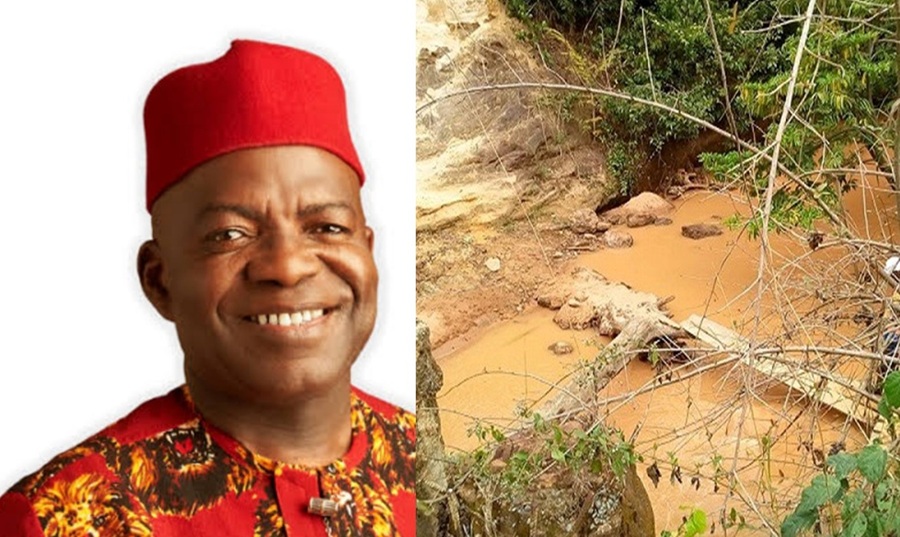
That expectation naturally brings one project into sharp focus, the reconstruction of the abandoned Mmam Bridge. Few public infrastructure projects in Abia North carry the symbolic, economic and historical significance of Mmam Bridge.
During the flag-off of the Ngodo–Umuaku–Mbala Road project on February 26, 2025, Governor Otti assured the people that he would direct the Commissioner for Works to assess the damaged bridge. That commitment rekindled hope among residents who have waited for generations to see meaningful government intervention.
The assessment was eventually conducted. However, months have gone-by, little has been publicly communicated regarding the next phase of the project. As the governor returns to Umunneochi, the people deserve clarity on the future of that commitment.
Mmam Bridge is far more than a collapsed structure. It is one of the most enduring reminders of interrupted development in the region.
Linking Isuochi in Umunneochi Local Government Area of Abia State with Achi in Oji River Local Government Area of Enugu State, the bridge still bears the scars of the Nigerian Civil War. Before its destruction, it served as a vital economic corridor connecting present-day Abia, Enugu and Anambra States, facilitating commerce, transportation and enduring social relationships.
Nearly six decades later, its absence continues to impose enormous economic and social costs. Communities that once traded freely now contend with longer travel distances, higher transportation costs, reduced commercial activity and diminished investment opportunities. Agricultural produce takes longer routes to markets, businesses lose competitive advantage, and residents continue to experience a level of isolation that should have disappeared decades ago.
For the people of Isuochi and indeed the entire Umunneochi area, Mmam Bridge has become more than a physical structure. It represents deferred justice, interrupted progress and decades of governmental neglect. Its reconstruction would, therefore, achieve much more than restoring a transport link.
It would reconnect communities separated for generations, revive economic activity across state boundaries, stimulate trade and agriculture, improve mobility, strengthen regional integration and demonstrate that responsive governance can finally resolve problems that previous administrations left unattended.
As political conversations ahead of 2027 gradually gather momentum, there is perhaps no single project capable of resonating more profoundly with the people of Isuochi and Umunneochi than the reconstruction of Mmam Bridge and its access roads. Infrastructure, after all, remains the most persuasive language of governance. Unlike political rhetoric, completed projects leave lasting evidence of leadership.
Governor Otti has earned a reputation as a courageous and reform-minded leader willing to confront longstanding challenges. That reputation gives the people of Umunneochi genuine reason to believe that their decades-long aspiration may finally become reality.
It is, therefore, not unreasonable for residents to hope that the governor’s July 24 visit will produce a definitive announcement on the reconstruction of Mmam Bridge and its access roads. Such a decision would rank among the most consequential development interventions ever undertaken in the area.
However, Mmam Bridge is only one component of Umunneochi’s infrastructure needs.
Other critical roads, including the Leru–Ndiawa–Nkwoagu Road, the Leru–Ngodo–Amuda Road, the Ezi Okaemee–Amuda–Umuaku–Owerri-Ezukalla Road, the Lomara–Ubahu–Eziama Nneato–Ndikelionwu Road, the Amuda-Achara-Enugu/Port Harcourt Expressway road, and the Umuchieze Ring Road, also deserve urgent government attention because of their importance to agriculture, commerce and rural connectivity.
No government can address every infrastructure deficit simultaneously. Development requires prioritisation, prudent allocation of resources and phased implementation. Yet priorities should always reflect strategic importance and long-term socio-economic impact. Measured against those standards, Mmam Bridge just like the iconic Omenuko Bridge in Arochukwu, deserves to rank among Abia State’s highest infrastructure priorities.
As Governor Otti arrives in Umunneochi, the people will rightly celebrate the remarkable progress his administration has recorded across Abia. At the same time, they will look beyond the speeches and festivities, hoping that this historic visit will produce a tangible commitment capable of changing the trajectory of the area for generations.
If the reconstruction of Mmam Bridge and other critical Umunneochi roads is prioritised, history will remember this administration not only for renewing Aba and transforming Umuahia but also for reconnecting a border community that had waited for far too long to enjoy the full dividends of governance.
Ultimately, Mmam Bridge is more than an inter-state crossing. It is a bridge between neglect and inclusion, between isolation and opportunity, between history and hope. Rebuilding it would not simply connect Abia and Enugu. It would reconnect the people of Umunneochi to the enduring promise of responsive governance, one that listens, acts and delivers.
*Rommy Imah, an indigene of Isuochi, is a Lagos-based media practitioner



