


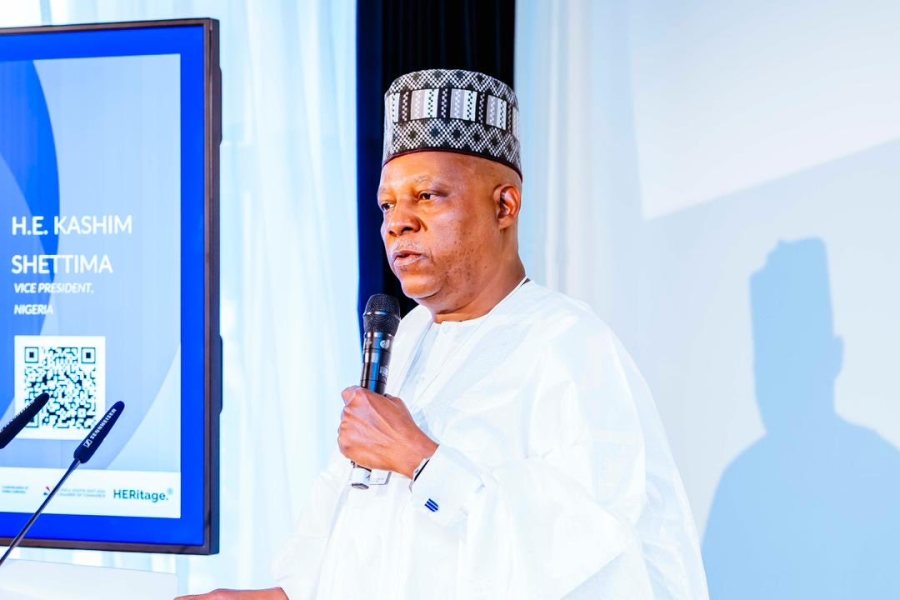
Senator Kashim Shettima, Nigeria’s Vice President, has said the country has no business being poor given its comparative advantage in human resources, agriculture and natural resources.
He made this known during a panel session titled “When Food Becomes Security” at the just-concluded World Economic Summit in Davos, Switzerland.
“Honestly, we have to look inwards and see to it that, as Africans, we find solutions to our problems. And honestly, we have no business being poor. I’m speaking from the bottom of my heart. In certain parts of Nigeria, our land is so rich that if you can plant money, it can grow. So it’s all about us embracing modernity,” he said.
The vice-president called on the Nigerian farmers to adopt modern farming best practices and techniques, noting that this would increase output and boost aggregate incomes.
“So all we need is to embrace modernity, improved agricultural practices, and fertilisation. You know, right now, the yield on some of our crops, like rice, is two to three tons per hectare. In some climes, they produce ten tons per hectare. The same thing with potatoes.
Most of our output is low compared to global standards. So be reassured that the trajectory, as I’ve always said, of global growth is based in Africa.”

Nigeria’s population is projected to reach over 400 million by 2050, making it the world’s third-largest country behind India and China.
Driven by a high fertility rate and a young population, this rapid growth, from over 230 million in 2024, is expected to surpass that of the United States.
“One out of every four Africans is a Nigerian, and by 2050, we’ll be the third most populous nation on earth. By 2050, we’ll be more populous than the United States”, he said.
Meanwhile, Ngozi Okonjo-Iweala, the director-general of the World Trade Organisation (WTO), said Nigeria needs to shift its focus from economic stabilisation to job creation and attracting global investments that will generate employment for the nation’s teeming youth population.
She disclosed this during a fireside chat at the Nigerian House at the just-concluded World Economic Forum (WEF) in Davos.
Targeting global investors for job growth and supply chain opportunities, she noted, would help drive innovation, boost industrialisation, improve productivity, contribute to GDP growth, and increase Foreign Direct Investment (FDI) and Foreign Portfolio Investment (FPI)q.
“What I’d like to see us doing is continue to try to attract investment into the country because there’s an opportunity now to attract all these supply chains.
“So if there’s one thing I’d like to see, everything we can do to show Nigeria as a country worthy of investing in, that’s what we should be doing.
“And we should deliberately have a strategy to go after those investments, to go after investors, to go to China, the United Nations (UN), whatever it takes to let them come and invest in our country .”