

Nigeria’s digital economy is no longer the future, It is the present. Startups are scaling. SMEs are going online. AI tools are entering everyday workflows.
Search behaviour is changing. Consumers are becoming more digitally sophisticated.
And in the middle of all this progress, one question quietly keeps surfacing: Are we preparing people for the economy that actually exists, or the one that existed ten years ago?
Let’s talk about that.
The Skill Gap No One Can Ignore
Before we go too far into technology trends, we need to address something foundational.
Because Technology is not the problem, Access is not the problem, Interest is not even the problem, The real issue is capability.
Many professionals want to enter tech. Many businesses want to grow online. Many graduates want digital jobs, but wanting is different from being equipped.
This is exactly where structured, implementation-focused platforms like the Odurinde eLearning platform come in, not as theory hubs, but as skill accelerators built around practical execution.
Now, why is this conversation urgent? Because the rules of digital visibility have changed dramatically.
Search Has Changed. Completely.
Let’s pause here for a moment. If you build a website today and nobody finds it, does it exist?
Visibility is currency in the digital economy. And that visibility is controlled largely by search engines, which are no longer what they used to be.
Search is becoming conversational, AI is generating summaries, Users are getting answers without clicking, Google’s AI Overviews are reshaping traffic patterns. This means SEO in 2026 is not the same as SEO in 2016.
And that is why enrolling in and learning through a modern, structured Search Engine Optimisation Training is essential today, instead of relying on outdated tactics that no longer reflect how search engines and AI-driven discovery actually work.
Because the uncomfortable truth is: Most people who say they know SEO are still operating on pre-AI strategies.
So before we talk about broader digital skills, we must understand this: If you cannot control visibility, you cannot control growth. Now let’s widen the lens.
Why This Isn’t Just About SEO
It might sound like this entire conversation revolves around search engines.
It doesn’t. SEO is simply the most visible example of a bigger shift, The real shift is this: The economy now rewards execution.
Let’s connect the dots.
A business needs:
- A properly built website
- It might be a secure WordPress infrastructure
- An Optimised loading speed
- A conversion-ready funnel
- A structured digital marketing strategy
SEO doesn’t work without web development, Marketing doesn’t convert without performance, Content doesn’t rank without structure.
That’s why skill stacking matters.
Through programmes in:

- Web Development
- WordPress Development
- Digital Marketing
- TOEFL preparation for global positioning
Edtech platforms like Odurinde eLearning approach digital training as an ecosystem not isolated courses. Because the digital economy is interconnected. And that brings us to something bigger than training.
The Degree vs Demonstrated Competence Reality
Let’s have an honest conversation. For decades, career progression followed a predictable formula: Study → Graduate → Apply → Hope.
But the digital economy works differently.
Employers are increasingly asking:
- Can you show me what you’ve built?
- Can you demonstrate ranking results?
- Can you optimise a live website?
- Can you analyse traffic and improve conversions?
Notice something? Those questions are not about certificates. They are about competence. This does not diminish formal education.
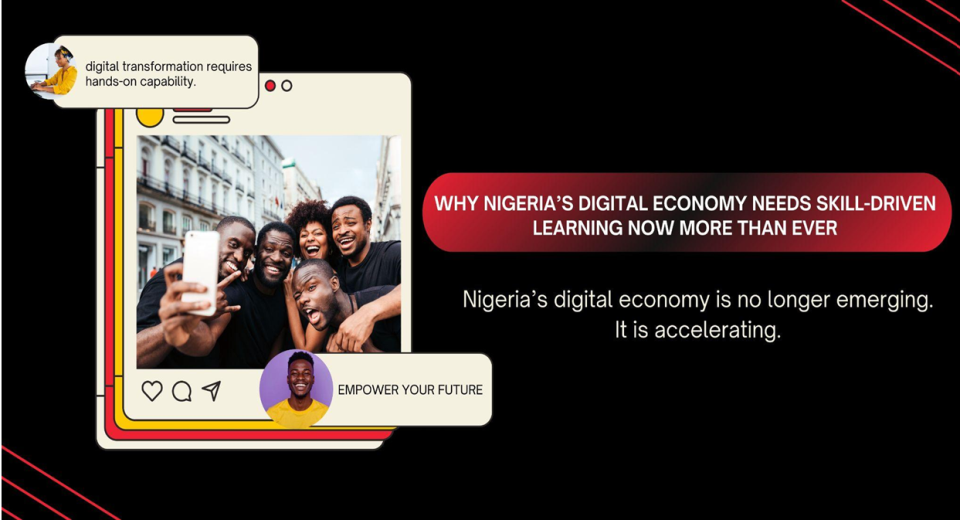
It simply acknowledges that digital transformation requires hands-on capability.
And this is where implementation-driven learning becomes powerful, it shortens the gap between learning and earning.
Now let’s zoom out even further.
Nigeria’s Strategic Moment
Nigeria has one of the youngest populations globally.
Digital adoption is increasing. Entrepreneurship is rising. Remote work is expanding.
The opportunity window is open. But opportunity alone is not enough. Without structured digital skills, opportunity becomes noise. With skill, opportunity becomes leverage.
The Nigerian tech ecosystem does not just need more startup ideas.
It needs more builders.
More optimisers.
More technical problem-solvers.
More strategically trained professionals.
And that is why this conversation about skill-driven learning is not just about education.
It is about economic competitiveness.
The Bigger Question We Should Be Asking
Instead of asking: “What course should I take?”
Maybe the better question is: “What digital problem can I solve, repeatedly and confidently?”
Because when you can:
- Build websites
- Optimise search visibility
- Secure digital platforms
- Structure content for AI
- Drive measurable growth
You are not just employable. You are valuable. And value, in an AI-driven, visibility-controlled digital economy, is the new security. Nigeria does not lack ambition. It does not lack intelligence. It does not lack creativity.
What it needs is Odurinde eLearning, a structured, modern, implementation-driven digital training platform aligned with how technology actually works today.
Because the future will not reward familiarity. It will reward capability. And capability is built deliberately.