


ADVERTISEMENT
Thursday, June 4, 2026
Tech | Business | Economy
No Result
View All Result
  • Technology
    • Trends
    • Telecoms
      • Broadband
    • ConsumerTech
      • Gadgets and Appliances
      • Apps
      • Accessories
      • Reviews
      • Unboxing
    • EnterpriseTECH
    • Security & Data Protection
    • How To
  • Business
    • Company News
    • StartUPs
      • Founder’s Story
      • Funding
    • Deals
    • People & Moves
    • SME & Entrepreneur Focus
    • BUSINESS SENSE FOR SMEs
    • Competition & Market Positioning
    • Commerce & Mobility
    • Travel
    • WomenPreneurs
  • Economy
    • Macroeconomic Trends
      • Macro Monday
      • TE Insights
    • Finance
      • Banks
      • Fintech
      • Insurance
      • Digital Assets
      • Personal Finance
    • Policies
      • Tech & Society
    • Market Analysis
    • Jobs & Workforce Economy
  • Features
    • Guest Writer
      • Chidiverse
      • Digital Assets
      • GameTech
    • EventDIARY
    • IndustryINFLUENCERS
    • MarkTECH
    • TBS
    • NewsEXTRA
  • Editorial
  • Brand Content
  • TECHECONOMY TV
Thursday, June 4, 2026
Tech | Business | Economy
No Result
View All Result
Tech | Business | Economy
No Result
View All Result

Home » Wole Soyinka Speaks to CNN, Highlights How Nigerian Literature has Made Changes in Society

Wole Soyinka Speaks to CNN, Highlights How Nigerian Literature has Made Changes in Society

…African Voices Changemakers aired on CNN International Saturday 21st September 2024 at 0830 SAST

Adetunji Tobi by Adetunji Tobi
September 28, 2024
in TechTAINMENT
Reading Time: 3 mins read
0
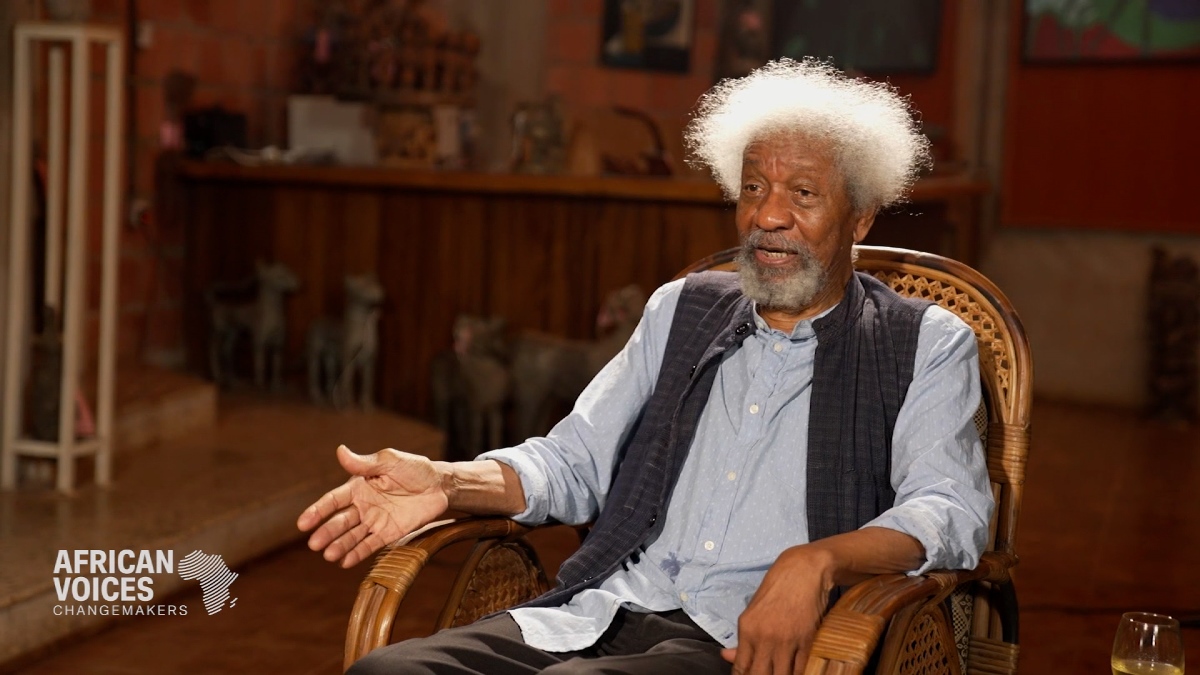
CNN chats with Wole Soyinka

Prof. Wole Soyinka

In the latest episode of African Voices Changemakers, CNN’s Larry Madowo meets Nigerian playwright, Wole Soyinka, to discuss his expansive body of work, as well as his political activism and what comes next.

Soyinka recently turned 90, and he reflects on his childhood and how he became politically aware, “I was a great eavesdropper on my parents, on the conversation going on, especially my father’s colleagues.

He was the head nurse, head teacher, and he had sort of coterie of argumentative people. And I was sitting there, I remember, behind an armchair. I was listening.”

Listening, Soyinka says, was his method of becoming politically alert. His involvement then progressed to “passing messages” as he recalls, “When all the rioting was taking place, I became a courier between the various women’s camps.”

The playwright speaks about how his mother’s participation in the Abeokuta riots planted the seed for his life’s work, “Being actually within the environment, that struggle of militancy against an unacceptable situation. That these women coming in, for instance, in the Kuti house, to report their encounters, they were called an Accord, the native police quote, and how their goods were being seized in the marketplaces if they didn’t pay taxes, some of them beaten up, roughed up and so on. And I took this side of the women in the most natural way. So that, yes, that reflected in my writing. No question at all.”

Subscribe to our Telegram channel for the latest updates.

Follow the latest developments with instant alerts on breaking news, top stories, and trending headlines.

Join Channel

It was the “stress and struggle” life under colonisation that allowed Soyinka to dream of, “What things could be like if society evolved along the kind of discussions which we listened to from the adults.”

He continues that contrastingly, now, life is, “Full of such complexities, such contradictions, such nuances, which involve unfortunately life and death decisions. We didn’t have all those in my childhood. So, there was a sense of greater leisure room for contemplation, and for even dreaming. These days, things happen so fast that I wonder if this young generation even has time to dream.”

Soyinka’s political actions often proved a problem for the Nigerian government. He recalls the time he broke into a radio station as he, “Felt compelled to stop the further broadcast of false results. I was part and parcel of the voting processes I witnessed at firsthand the destruction of polling booths, even the tearing up of results.”

He explains that this was due to the reinstatement of, “The most cynical regime, which went so far as to declare on radio at the time and television had begun to say that we don’t give a damn. If you vote for us, the angels in heaven are already here So, it was part of an ongoing struggle on so many levels.”

While he was tried and acquitted for breaking into the radio station, he later spent 27 months in prison, including 22 months in solitary confinement.

He recounts his time there, saying, “It was a very testing period for me. The prisoner has to survive. I began recollecting those formulae in geometry, trigonometry, which I had hated. I began pulling them back and making calculations on the ground

Soyinka tells Madowo that he wrote the notes for his memoir, The Man Died, in isolation using meat bones, handmade ink, and toilet paper.

It recounts his political activism and imprisonment for an alleged link to the Biafran army at the height of the Nigerian civil war.

His collection of successful writing earned him the Nobel Prize in Literature in 1986, the first African to receive this prize. Soyinka describes his experience of this time as “isolated.”

He elaborates, “I was most relieved when the next African came because so much was demanded of you. It was like, overnight, your constituency expanded simply because you are an African, you come from the African continent.”

But more than this, it exposed Soyinka to great dangers, “I always remind people that the most brutal dictators were had here, Sani Abacha would’ve gone to his grave a happy man if he’d hanged a Nobel Laureate, if he may able to put on his CV that I hanged a Nobel Laureate.”

This year, for his 90th birthday, Nigerian President Bola Tinubu renamed Nigeria’s national theatre after him, honouring Soyinka’s legacy.

Similarly, his hometown of Abeokuta celebrated him through ‘The Whole Soyinka International Cultural Exchange’ project. Not only is Soyinka recognised for his support of young critical thinkers, but he also helps “promote a number of my student’s work.”

Soyinka ends the interview with a dark-humoured look into his future, “I don’t want to be morbid, but you know that’s the future. But I made an arrangement for that within this estate.”

More optimistically, he says retirement from his vocation means he can, “resume certain activities that will give me pleasure” and “for about a week or two weeks go anywhere in the world and just be a tourist.”

0Shares
Previous Post

SystemSpecs Continues to Strengthen Tech Development in Nigeria

Next Post

Mezzan Holding Transforms its Financial Planning with Successful Corporate Planning Integration

Adetunji Tobi

Adetunji Tobi

Tobi Adetunji is a Business Reporter with Techeconomy. Contact: adetunji.tobi@techeconomy.ng

Related Posts

Spotify podcast clips feature

Spotify Launches ‘Clips’ to Let Users Cut and Share Podcast Snippets

May 27, 2026
Sony Shuts Down Destruction AllStars Multiplayer

Sony Shuts Down Destruction AllStars Multiplayer, Delists PS5 Game from PlayStation Store

May 27, 2026

Spotify Expands Beyond Music and Podcasts with Narrated Magazine Articles

May 26, 2026
Load More
Next Post
Mezzan Holding

Mezzan Holding Transforms its Financial Planning with Successful Corporate Planning Integration

Leave a Reply Cancel reply

Your email address will not be published. Required fields are marked *

I agree to the Terms & Conditions and Privacy Policy.

This site uses Akismet to reduce spam. Learn how your comment data is processed.

Techeconomy Podcast
Techeconomy Podcast

The Techeconomy Podcast is a thought-leadership show exploring the powerful intersection of technology, business, and the economy, with a strong focus on Africa’s fast-evolving digital landscape.

Financing the Future: Venture Debt, Local Capital & African Innovation | TBS May 2026 Webinar
byTecheconomy

Africa’s innovation ecosystem is evolving, but where will the funding for the next generation of startups come from?

In this edition of the Techeconomy Business Series (TBS) May 2026, industry experts explore how local capital, venture debt, and smarter investment structures are redefining startup growth and innovation across Africa.

🎙️ Featured Speakers:

* Ebunoluwa Ashley-Dejo

* Damilare Davola

* Success Ajilore (STN & Accelerated Plus)

Key conversations in this webinar include:

✔️ The future of startup financing in Africa

✔️ Venture debt and alternative funding models

✔️ The role of local investors in scaling innovation

✔️ Sustainable investment strategies for African startups

✔️ Opportunities and challenges in the African tech ecosystem

Subscribe for more conversations shaping Africa’s digital economy and innovation landscape.

#TBS2026 #AfricanInnovation #VentureDebt #StartupFinance #TechInAfrica #Techeconomy #AfricanStartups #InnovationEconomy

Financing the Future: Venture Debt, Local Capital & African Innovation | TBS May 2026 Webinar
May 27, 2026
Techeconomy
PROTECTING INNOVATION IN AFRICA’S STARTUP ECOSYSTEM
April 29, 2026
Techeconomy
BUILDING TRUST IN AFRICA ECOSYSTEM
February 27, 2026
Techeconomy
Navigating a Career in Tech Sales
January 29, 2026
Techeconomy
How Technology is Transforming Education, Health, and Business
November 27, 2025
Techeconomy
Search Results placeholder
MTN Live It 100 Thematic Campaign
ADVERTISEMENT
  • About Us
  • Careers
  • Contact Us
  • Privacy Policy

© 2026 TECHECONOMY.

No Result
View All Result
  • Technology
  • Business
  • Economy
  • Features
  • Editorial
  • Brand Content
  • TECHECONOMY TV

© 2026 TECHECONOMY.

This website uses cookies. By continuing to use this website you are giving consent to cookies being used. Visit our Privacy and Cookie Policy.


