
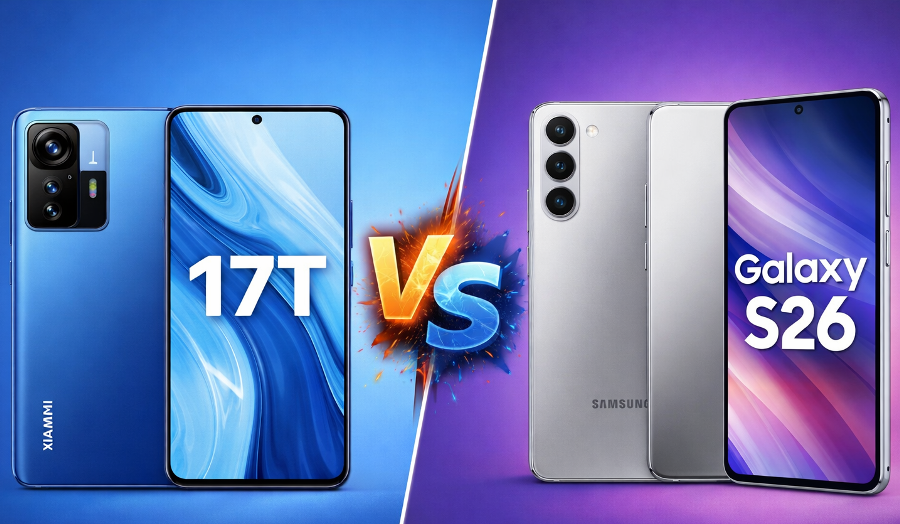
Just as May was drawing to a close, Xiaomi launched the Xiaomi 17T series, skipping the 16T naming to align more closely with flagship branding trends seen across the industry.
These include Apple’s iPhone 17 range and Samsung’s Galaxy S lineup.
Don’t get confused with the 17 Ultra (Leitz Phone) reviewed earlier in the year, because the 17T belongs to a different Xiaomi lineup positioned as a “flagship killer”, even though it still carries Leica-backed camera hardware.
It also sits well below the premium Leitz Phone in pricing, making it a more accessible high-end option.
That said, the Xiaomi 17T is still priced above Samsung’s mid-range Galaxy A-series, such as the Galaxy A57. The A-series is focused on affordability and balanced performance, while the 17T pushes into near-flagship territory with premium specifications at a lower cost.
For this reason, a better comparison is with the Galaxy S26 series from Samsung.
While the Galaxy S26 comes first in raw performance and refinement, the Xiaomi 17T is designed to challenge flagship devices by offering similar features at a lower price point.
This comparison is especially relevant in Nigeria, where many buyers want premium smartphone experiences but are very much price-sensitive.
Below are the areas that are most important to Nigerian buyers spending above ₦500,000 on a smartphone.
Battery and Charging
Battery life and charging speed are top priorities for smartphone users in Nigeria. Even at premium price points, consistent electricity access is not always guaranteed, making fast charging and long battery life essential.
- Xiaomi 17T: 6500mAh Si-C battery with 67W fast charging
- Xiaomi 17T Pro: 7000mAh Si-C battery with 100W fast charging
- Galaxy S26 (standard): 4300mAh with 25W charging
- Galaxy S26 Ultra: 5000mAh with 60W charging
In this category, the Xiaomi 17T comes out ahead. Its larger battery capacity and faster charging speeds make it more practical for daily use in Nigeria.
While the Galaxy S26 benefits from strong optimisation and efficiency, the 17T’s ability to recharge quickly and last longer under heavy usage gives it a real-world advantage.
Creativity and Productivity
Many Nigerians buying smartphones in this price range are not casual users, as they often rely on their devices for content creation, business operations, and multitasking.
The Xiaomi 17T is powered by the MediaTek Dimensity 8500 chipset, which still trails the Snapdragon 8 Elite Gen 5 found in the Galaxy S26 series. However, it is capable enough for demanding productivity tasks.
Its larger display and stronger battery performance also help offset the performance gap, especially for users who work long hours on their phones.
- Xiaomi 17T: 6.57-inch AMOLED (6.83-inch on Pro), 120Hz refresh rate, 3500 nits brightness
- Galaxy S26: 6.3-inch Dynamic AMOLED 2X, 120Hz refresh rate, 2600 nits brightness
The Galaxy S26 provides a more refined overall experience and stronger raw performance. But then, its smaller battery may feel limiting for users who spend extended hours editing content, multitasking, or streaming.
Camera Setup
Camera performance is a deciding factor for many premium smartphone buyers in Nigeria. Expectations go beyond basic photography, with many users now seeking near-professional imaging capabilities.
Both devices deliver high-end camera systems, but they prioritise different strengths.
The Xiaomi 17T stands out with its 50MP periscope telephoto lens and stronger zoom capabilities, making it more flexible for photography enthusiasts. Backed by Leica tuning, it also appeals to users who prefer manual controls and a more “cinematic” shooting style.
Samsung, meanwhile, is still leading in computational photography. The Galaxy S26 produces consistent, natural-looking images with excellent dynamic range and industry-leading point-and-shoot reliability.
In simple terms, Xiaomi provides more creative flexibility, while Samsung delivers more consistent results with less effort.
Availability in Nigeria
The Xiaomi 17T has only recently begun its global rollout following its launch in late May. Historically, Xiaomi has brought its T-series devices to Nigeria shortly after international release.
For context, the Xiaomi 15T launched globally on September 28 and arrived in Nigeria by October 7. If that pattern continues, the 17T series should be available in Nigeria very soon.
Pricing
Pricing is one of Xiaomi’s strongest selling points in this comparison.
- Xiaomi 17T: starts at $699 (≈ ₦950,000)
- Xiaomi 17T Pro: starts at $799 (≈ ₦1.08 million)
- Galaxy S26 series: ranges from $899 to $1,299 (≈ ₦1.2 million to ₦1.8 million+)
This places the Xiaomi 17T well below the Galaxy S26 lineup, making it an attractive option for buyers who want flagship-level features without paying full flagship prices.
The Galaxy S26 is the more polished flagship overall, offering superior performance, refinement, and software optimisation.
However, the Xiaomi 17T provides stronger value for money. For buyers in Nigeria prioritising battery life, fast charging, strong cameras, and premium features at a lower price point, it presents one of the most satisfactory alternatives in today’s smartphone market.