


In Abraka’s bustling markets and Sapele’s workshop alleys, the rhythm of small business life is familiar: early mornings, long days, and the constant search for capital to grow.
For micro, small and medium enterprises (MSMEs) across Delta State, access to affordable finance has often felt like chasing a promise that recedes instead of arriving.
This story, however, is shifting.
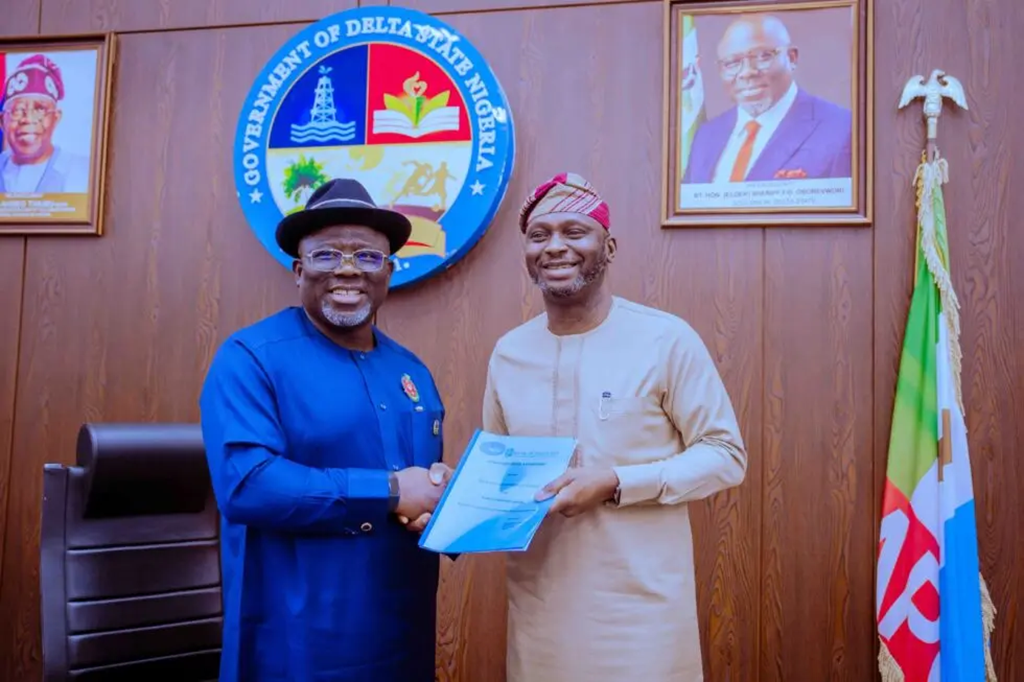
On January 14, 2026, Governor Sheriff Oborevwori stood before a gathering of business owners, entrepreneurs, and community leaders with more than words.
He delivered on a promise that had been forming quietly over months of planning, consultation, and coordination, a ₦1 billion revolving MSME fund, injected into the Bank of Industry (BOI) to catalyze entrepreneurship and business expansion across the state.
From Struggle to Strategy
For years, Delta’s MSMEs, from tailors in Ughelli to carpenters in Warri, have shared variations of the same story: “We have the ideas and the customers, but not the capital to scale.”
Banks often require collateral that small traders simply do not possess. Informal borrowing, from friends, family, or micro-lenders, can fuel short stints of growth, but at high cost.
Many promising ventures stall not from lack of ambition, but from lack of accessible credit.
Recognizing this gap, the Oborevwori administration made MSME support a central plank of its economic agenda, conceived not as charity, but as structural investment in local enterprise.
A ₦1 Billion Infusion with Purpose
The ₦1 billion revolving fund, placed with the Bank of Industry (BOI), is designed specifically to address the credit bottleneck that has long slowed grassroots business growth. Unlike grants that disappear once spent, revolving funds return to the pool as loans are repaid, creating a sustainable engine of support for future borrowers.
Governor Oborevwori explained the logic in simple terms, when he handed over the funds:

“This initiative is about more than money. It’s about belief… belief in our entrepreneurs, their capacity, and the future of our economy.”
His message resonated with the audience, not as political rhetoric, but as a tangible lifeline to businesses that had, until now, operated at the margins of Nigeria’s broader economic momentum.
What the Fund Means on the Ground
For artisans, traders, and small manufacturers, the new fund represents more than capital, it is recognition and validation.
Take the example of Amara, a fashion designer in Asaba whose orders often outpace her working capital. She once spent weeks turning down bulk contracts because she simply could not afford upfront costs for materials and labour.
“This fund means I can finally take the big orders without fear,” she said, eyes glinting with the hope of expansion.
For others like Mr. Ugo, who runs a food processing outfit in Oleh, the fund offers the promise of equipment upgrades and access to larger distribution channels previously beyond reach.
The Bigger Picture: Jobs, Growth, and Inclusion
Delta State’s economy is not monolithic. While the oil and gas sector dominates headlines, MSMEs are the real engine of local livelihoods, employing thousands and circulating wealth through communities.
By partnering with the BOI, a financial institution with experience in SME lending, the state government hopes to achieve not only business growth, but job creation, economic inclusion, and resilience against economic shocks.
The revolving nature of the fund is key. As loans are repaid, more entrepreneurs will gain access to credit. Over time, the pool could swell, enabling deeper financial penetration into every corner of the state.
A Turning Point for Delta’s Business Ecosystem
To many entrepreneurs in Delta, January 14, 2026 will be remembered not as another political date, but as a turning point: the day when a government moved beyond promises and invested directly in the potential of its people.
As the first tranche of loans begins to flow, business owners will be watching not just for capital, but for outcomes, new shops opened, machines bought, jobs created, and a renewed sense of possibility on the streets and marketplaces where daily life unfolds.
For Delta’s MSMEs, the road ahead may still be long. But with a ₦1 billion boost and a commitment to sustainable financing, it now looks a little clearer, and a lot more hopeful.