Twenty-five years ago today, on May 16, 2001, a signal crackled across a base station in Lagos and a call was placed, the first ever on a GSM network in Nigeria.
The caller was not a government official or a billionaire, but the moment was seismic. Nigeria then had fewer than 400,000 connected telephone lines for a population of over 120 million people. Getting a landline was considered a luxury, often requiring years of waiting, heavy unofficial costs, and privileged connections. For most Nigerians, access to telecommunication services was simply out of reach.
That first call was placed on the MTN Nigeria network. It began one of the most consequential corporate stories in African economic history, a story of explosive subscriber growth, billion-naira fines, currency crises, fintech ambitions, and, ultimately, the rewiring of everyday Nigerian life.

As MTN Nigeria marks 25 years of commercial operations, Techeconomy looks at 25 documented milestones and industry firsts, the operator’s measurable economic impact, its role in education, fintech and the startup ecosystem, the persistent tensions around data sovereignty and regulatory compliance, and the unfinished agenda that will define the next chapter.
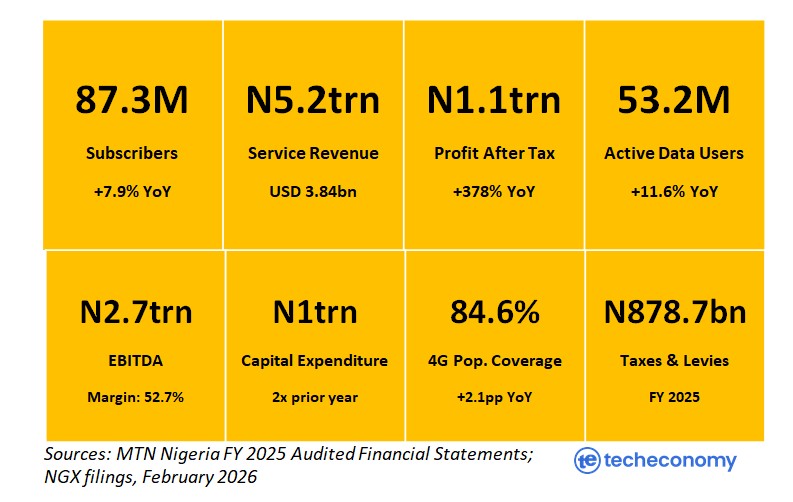
MTN Nigeria at a Glance – FY 2025
Part One: 25 Milestones & Industry Firsts
Milestones are not marketing; they are data points. The following 25 events, drawn from NCC filings, NGX listing memoranda, company disclosures, and independent reporting, chronicle the arc of MTN Nigeria’s quarter-century, from a greenfield GSM licence to a multi-product digital platform serving nearly 90 million Nigerians.
| YEAR | MILESTONE / FIRST |
| 2001 | First GSM call in Nigeria, May 16, 2001. MTN becomes the first network to place a commercial call following the NCC’s landmark spectrum auction, beating rivals Econet and M-Tel to the signal. |
| 2001 | Full commercial launch in Lagos, Abuja & Port Harcourt (August 2001) within seven months of winning the licence, a logistics feat given Nigeria’s infrastructure deficit at the time. |
| 2001 | 50,000 subscribers by September 2001, just five weeks after commercial launch, far outpacing internal projections and signalling enormous pent-up demand. |
| 2002 | 500,000th customer connected by June 2002. Nigeria’s telephone access had been a luxury for a tiny elite; MTN was democratising it at scale. |
| 2003 | Per-second billing introduced, a first in the Nigerian market, following competitive pressure from Globacom’s entry. The move slashed effective call costs and accelerated mass-market adoption. |
| 2003 | One million subscribers milestone crossed, cementing MTN’s early dominance of an industry where rivals were still stabilising their networks. |
| 2004 | Two million subscribers; 900 base stations operational, with coverage extending across inter-city highways and over 2,000 communities – a network footprint no incumbent had contemplated. |
| 2006 | 10 million subscribers’ milestone – Nigeria’s fastest-growing consumer product at the time. MTN awarded a Unified Access Service Licence (UASL) by the NCC, enabling fixed, mobile and broadband services under one licence. |
| 2008 | First operator to deploy a 3G/HSPA+ network in Nigeria, offering mobile broadband speeds up to 42 Mbps in major cities and marking Nigeria’s first foray into mobile internet beyond GPRS. |
| 2013 | 50 million subscribers’ milestone. MTN Nigeria becomes one of the largest single-country mobile networks on the African continent. |
| 2015 | The NCC slaps a record N1.04 trillion (USD 5.2 billion) fine on MTN Nigeria for failure to deactivate 5.2 million improperly registered SIM cards by the regulatory deadline. The fine is eventually negotiated down to N330 billion after government-level diplomacy and leadership changes. |
| 2016 | MTN Nigeria wins the 2.6GHz spectrum band (2x 30 MHz) for LTE deployment as the sole approved bidder, building what would become one of Africa’s largest 4G networks. |
| 2018 | 4G LTE commercial service extended to more than 14 cities; over 25,800 km of fibre backbone deployed the largest fixed mobile network in Africa at the time. |
| 2019 | MTN Nigeria lists on the Nigerian Stock Exchange (NSE) via Introduction, trading under ticker MTNN, the largest listing in NGX history by market capitalisation at the time, a direct condition of the 2015 fine settlement. |
| 2019 | Subscriber base reaches approximately 67 million, according to NCC data; MTN commands roughly 39% market share of Nigeria’s total active mobile subscriptions. |
| 2019 | MTN Nigeria commits to invest N640 billion (USD 1.5 billion) over three years in broadband infrastructure aligned with the Federal Government’s 2020–2025 National Broadband Plan. |
| 2021 | MTN Foundation Scholarship Programme surpasses 14,000 beneficiaries since inception in 2010 across science, technology, and inclusion-focused categories including blind students. |
| 2022 | Nigeria’s first commercial 5G licence awarded to MTN Nigeria and MAFAB Communications by the NCC in December 2021 (operational from August 24, 2022), making Nigeria one of the first sub-Saharan African nations to launch 5G. MTN’s median 5G download speed subsequently clocked 235 Mbps, 6.4 times faster than 4G. |
| 2022 | MoMo PSB (Payment Service Bank) licence granted by the Central Bank of Nigeria. MTN’s formal entry into regulated financial services, generating 7 million transactions within the first six weeks of operation. |
| 2022 | Network sharing agreement signed with Airtel Nigeria covering 4,200 RAN sites, projecting USD 150 million in combined capex savings over three years and accelerating rural coverage obligations. |
| 2023 | Active data users surpass 40 million; data becomes MTN Nigeria’s largest single revenue line, overtaking voice, a structural shift in the Nigerian telecoms economy reflecting smartphone penetration growth. |
| 2025 | Revenue crosses N5.2 trillion (USD 3.84 billion) for the first time; Nigeria surpasses South Africa as MTN Group’s single largest contributor to EBITDA, a reversal that underlines the weight of Nigeria in continental telecoms. |
| 2025 | MTN invests N1 trillion in capital expenditure in a single financial year, doubling its 2024 capex, following the NCC-approved 50% tariff adjustment, the sector’s first significant price revision since 2013. |
| 2025 | Home broadband subscriber base (FWA + FTTH) reaches 4.2 million, with 1 million net additions in the year, establishing MTN as Nigeria’s leading fixed-wireless broadband provider. |
| 2025 |
Launch of the ‘From Africa, for Africa’ accelerator programme backed by a N100 million fund, providing Nigerian startups in fintech, agritech, health, AI and cybersecurity with access to MTN’s cloud, MoMo APIs and data analytics infrastructure. |
Economic Impact
Transformation of Nigeria’s Teledensity
The most arresting data point in MTN Nigeria’s 25-year story is not a financial metric rather a structural one. In early 2001, Nigeria had around 400,000 fixed telephone lines for a population exceeding 128.5 million. Teledensity was below 1%.
By April 2023, the NCC recorded 223.6 million phone subscribers, a teledensity of 117%, with 157 million internet subscribers and 92 million broadband connections representing 48% broadband penetration.
The country had moved, within a single generation, from a communications desert to one of Africa’s most connected nations. MTN was not the only contributor to this transformation, but it was the catalyst.
GDP Contribution & Sector Performance
Nigeria’s telecommunications and information services sector is now the third-largest contributor to real GDP, behind agriculture and trade, according to NBS data for Q2 2024. The telecom sector contributed N2.508 trillion to GDP as recently reported, growing at 14.13% year-on-year in Q1 2023, the second consecutive year of double-digit growth.
MTN Nigeria, as the sector’s dominant player with over 37% market share by active subscribers (and over 50% by some Telegeography estimates), is the single largest private-sector driver of this output.
MTN Nigeria’s own revenue trajectory underscores the scale of value creation: from a nascent operator in 2001 to a company reporting N5.2 trillion (USD 3.84 billion) in full-year service revenue in 2025, a figure that would rank it among the top 10 companies on the Nigerian Stock Exchange by turnover. Its 2025 EBITDA of N2.7 trillion, at a margin of 52.7%, represents one of the most profitable large-scale operations in Nigerian corporate history.
Tax Contributions
MTN Nigeria paid N878.7 billion in taxes and levies in FY 2025 alone, a figure that dwarfs the budgets of multiple Nigerian state governments. In 2025, the company’s full tax charge under the newly implemented Nigeria Tax Act 2025 amounted to N583.18 billion (USD 429.7 million), representing 34.38% of net profit.
This was a reversal from a N149.89 billion tax credit in 2024 (itself a product of foreign exchange losses under the naira unification policy), and reflects the structural impact of fiscal reform on Nigeria’s largest corporate taxpayers.
Over its 25-year lifespan, MTN Nigeria has contributed hundreds of billions of naira in corporate taxes, import levies, spectrum fees, right-of-way charges, and the landmark N330 billion SIM registration fine, an involuntary but significant fiscal contribution to federal revenues.
The company’s 2019 NSE listing, itself a condition of the fine settlement, created one of the most widely held equity securities in the Nigerian retail investor market.
Employment & Indirect Economic Activity
MTN Nigeria directly employs thousands of workers and supports hundreds of thousands of indirect jobs through its distribution network of agents, dealers, and resellers.
Even if it sales the majority stakes in MoMo PSB, the 800,000+ agents constitute a micro-enterprise ecosystem in their own right, providing livelihoods in urban and peri-urban markets.

The operator’s capital expenditure commitments, N1 trillion in 2025 alone, flow into construction, logistics, equipment distribution, tower maintenance, and fibre deployment, multiplying through the broader economy.
|
MTN Nigeria’s 2025 revenue of USD 3.84 billion makes it Nigeria’s top contributor to MTN Group EBITDA, surpassing South Africa for the first time. Nigeria now accounts for more than a quarter of Group service revenue. — MTN Group 2025 Full-Year Results, March 2026 |
Impact on the Telecommunications Sector
Market Structure & Competition
Again, MTN’s arrival in 2001 did not merely add capacity to Nigeria’s telecom sector, it created the sector. The NCC’s landmark GSM auction of January 2001 was itself the product of institutional courage: a public, transparent process that replaced a cancelled, scandal-ridden private tender.
MTN, Econet (later Airtel), and M-Tel each paid USD 285 million for their licences. MTN’s aggressive rollout put pressure on rivals and set the competitive tempo for an industry that would eventually expand to include Globacom (2003), Etisalat/9mobile (now T2) (2008-09), and multiple MVNOs from 2025.
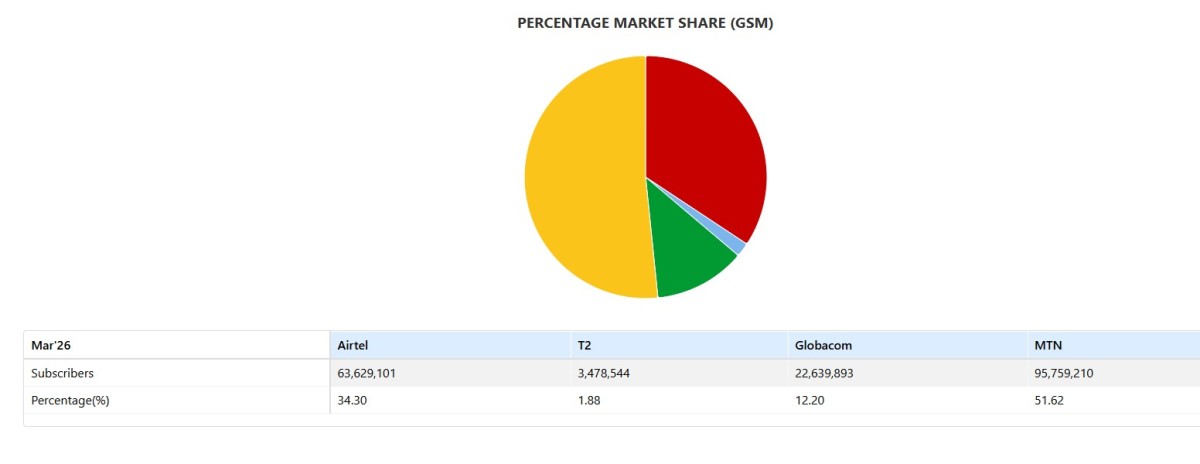
Today, Nigeria’s mobile market is a four-player oligopoly dominated by MTN (51.62% share) and Airtel (34.30%), followed by Globacom (12.20%) and T2, formerly 9mobile (1.88%), according to March 2026 NCC data.
MTN’s consistent network leadership, winning 14 out of 15 awards in Opensignal’s inaugural Nigeria Mobile Network Experience Report for the April-June 2025 period, including the overall Best Network title, has maintained its commercial dominance across three decades of changing technology generations.
Infrastructure Development
MTN’s fibre backbone, which now exceeds 30,000 km, underpins not only its own network but wholesale connectivity services for smaller ISPs and enterprise customers.

The company’s Dabengwa Data Centre is one of the few Tier III certified facilities in Nigeria, supporting hyperscale demand and regulatory data residency requirements. A March 2025 reciprocal RAN-sharing agreement with Airtel covering 4,200 sites, generating an estimated USD 150 million in combined capex savings over three years, signals a maturing sector moving from competitive duplication to infrastructure efficiency.
Technology Generational Leadership
MTN Nigeria has led or co-led every technology generation transition in Nigerian mobile history: the first 2G GSM call in 2001, 3G/HSPA+ deployment in 2008, 4G LTE launch by 2016, and 5G commercial operations from August 2022 with one of the first licences in sub-Saharan Africa.
By early 2025, 5G subscriber adoption had reached approximately 4.39 million (2.6% of the mobile base), with 5G adoption hampered by device affordability, infrastructure costs, and economic headwinds rather than network readiness.
MTN’s 5G download speeds of 235 Mbps, 6.4 times faster than 4G, position the infrastructure well for enterprise use cases including cloud surveillance, IoT, and private networks.
Tariff Reform & Sector Sustainability
One of the most significant structural developments in 2025 was the NCC’s approval of a 50% tariff adjustment, the first meaningful price revision since 2013. After years of operating under tariff structures eroded by naira depreciation (from approximately N307/USD in 2015 to a trough of N1,600/USD in 2024), MTN and other operators faced a systemic sustainability crisis.
MTN Nigeria’s 2024 loss of N400.44 billion, on record revenues of N3.36 trillion, illustrated the paradox of a revenue-rich, loss-making company battling forex losses of N925.36 billion.
The 2025 tariff adjustment, while controversial among consumer advocacy groups, enabled MTN’s dramatic profit recovery: a N1.1 trillion profit after tax in 2025, and a doubling of capex to N1 trillion, funding the network upgrades that will sustain service quality.
Impact on Education
The MTN Foundation Scholarship Programme
Established in 2010, the MTN Foundation Scholarship Programme has awarded over 14,700 scholarships across three categories: the Science and Technology Scholarship (STS) for 300-level students in public tertiary institutions; the Scholarship for Blind Students (SBS) since 2012; and the Top 10 UTME Scholarship, introduced in 2020, automatically awarded to the ten highest-scoring JAMB candidates each year.

In the 2026 cycle, 400 students are receiving STS awards of N300,000 each until graduation, conditional on maintaining academic standards. An additional 60 blind students receive N200,000 annually. These awards span 44 federal and state-owned institutions.
The programme’s three-tiered structure, covering STEM achievement, disability inclusion, and meritocratic secondary-to-tertiary pathways, reflects a considered, if modestly funded, approach to addressing Nigeria’s human capital gap.
Media Innovation Programme (MIP)
The introduction of MTN Media Innovation Programme, in 2022, in facilitated by the School of Media and Communications (SMC), Pan-Atlantic University, has become one of the most significant capacity-building initiatives for journalists and media professionals in Nigeria’s technology and business ecosystem.
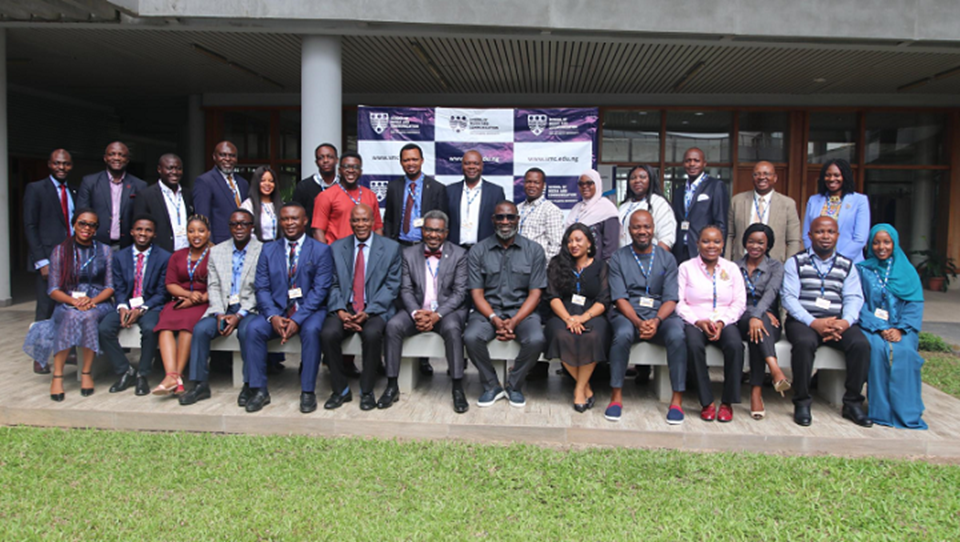
Its importance lies in equipping journalists with deeper understanding of telecommunications, digital economy trends, innovation, fintech, AI, and emerging technologies, improving the quality of tech reporting in Nigeria. It may sound demeaning to say some who ‘report ICT or telecom’ could not differentiate between telecom subscribers and subscriptions. It is a fact!
Aside the being better equipped with the understanding of the industry and its peculiarities, MIP participants gain exposure to multimedia storytelling, data journalism, digital reporting tools, and modern newsroom practices required in today’s rapidly evolving media landscape.
By my estimation, MTN Nigeria would have spent N1.5billion on the project from Cohort 1 to Cohort 5!
By exposing journalists to industry realities, regulation, and innovation ecosystems, the programme helps reduce misinformation and improves balanced reporting on telecoms and technology issues.
Fellows interact directly with telecom executives, policymakers, academics, and innovators, giving them access to insights that strengthen analytical and policy-focused journalism.
Overall, the MTN Media Innovation Programme has evolved beyond a corporate training initiative into a strategic platform for strengthening technology journalism and digital economy discourse in Nigeria.
Digital Skills & the 3MTT Programme
Beyond formal scholarships, MTN Nigeria committed N3 billion to the Federal Government’s 3 Million Technical Talent (3MTT) programme, which had trained more than 90,000 Nigerians in digital skills by mid-2025.
The company’s Y’ellopreneur programme, meanwhile, provides business literacy and financial management training to SME owners and market traders, segments that form the informal backbone of Nigeria’s consumption economy.
MTN Nigeria also distributes STEM scholarships and has, per its Q3 2025 earnings disclosure, distributed over 25,000 learning materials as part of its education-focused CSI commitments.
The company also runs internship placements for scholarship recipients within its technical divisions, providing industry exposure to students who might otherwise graduate without sector-relevant experience.
Connectivity as an Educational Infrastructure
The most profound educational impact of MTN’s 25 years is infrastructural rather than philanthropic. Nigeria’s telecom penetration growth, from near-zero in 2001 to 117% teledensity, has enabled e-learning, EdTech platforms, digital libraries, and remote schooling at scale.
MTN’s network is the underlying infrastructure for virtually every digital education service operating in Nigeria, from Coursera access in Abuja to WhatsApp-based lesson distribution in rural Kebbi State. The 55 million active data users on MTN’s network as at March 2026, with average usage of 13.1 GB per subscriber per month, represent millions of Nigerians accessing educational content that was physically inaccessible a generation ago.
Startups and the Digital Economy
Startup Enablement & the Accelerator Ecosystem
In July 2025, MTN Nigeria launched its ‘From Africa, for Africa’ accelerator, a 12-week programme backed by a N100 million (USD 65,200) fund targeting startups across fintech, agritech, health, AI and cybersecurity.

Selected cohort companies receive access to MTN’s cloud services, MoMo APIs, and data analytics tools, a meaningful competitive advantage given the cost of building equivalent infrastructure independently. A demo day connects startups with investors and potential partners.
The programme enters a competitive accelerator market that includes Google for Startups Accelerator Africa and Telecel-Startupbootcamp AfriTech. MTN’s differentiator is infrastructure access: few accelerators can offer startups a ready-made distribution network and API access to one of Africa’s largest mobile money platforms.
The structural question is whether the N100 million fund is commensurate with the ambition, by comparison, the 3MTT programme commitment of N3 billion suggests the potential for significantly deeper startup investment.
MTN as Enabler of Nigeria’s Tech Ecosystem
Nigeria’s tech startup ecosystem, which produced Flutterwave, Paystack, Andela, and dozens of other unicorns and near-unicorns, was built on mobile connectivity infrastructure that MTN primarily provides.
Every mobile payment, USSD banking session, WhatsApp Business interaction, and API-driven transaction by Nigeria’s 50+ million active internet users traverses, in large part, MTN’s network. The operator’s enterprise segment, which recorded 54.7% revenue growth in Q1 2025, reflects the growing commercialisation of this infrastructure role, from IoT connectivity for energy and logistics companies to SLA-backed low-latency services for financial traders in Lagos’s Marina district.
Data Sovereignty, Regulations and Unresolved Tensions
No episode in MTN Nigeria’s history is more instructive, or more contested, than the N1.04 trillion SIM registration fine of October 2015.
The NCC fined MTN N200,000 per unregistered SIM for 5.2 million lines that had not been deactivated by the regulatory deadline.
The fine, equivalent to USD 5.2 billion, was the largest regulatory penalty ever imposed on a telecommunications company in Africa. MTN’s share price fell 20% on the Johannesburg Stock Exchange within days.
The episode illuminated several structural tensions: the gap between Nigeria’s regulatory ambitions and its enforcement infrastructure; the political leverage that a company representing one-third of MTN Group’s global revenue can exercise through diplomatic channels; and the SIM registration regime’s role as a data sovereignty instrument.
The fine was ultimately settled at N330 billion, a 68% reduction, paid over a staggered schedule completed by 2019, with the NSE listing as a partial quid pro quo.
The settlement revealed that regulatory independence, while constitutionally enshrined in the NCC Act, is subject to executive-level influence in practice.
Data Localisation & the Foreign Operator Question
MTN Nigeria is a subsidiary of MTN Group, a South African multinational. This ownership structure raises persistent questions about data sovereignty: where is subscriber data stored, processed, and potentially accessed by foreign intelligence services?
The NCC’s data localisation requirements, the CBN’s directives on MoMo PSB data residency, and the passage of Nigeria’s Data Protection Act 2023 have progressively tightened the regulatory framework around data handling.
MTN’s Tier III certified Dabengwa Data Centre in Nigeria represents a physical investment in local data infrastructure, but critics argue that ownership and operational control of data flows in a foreign-headquartered entity cannot be fully governed by national regulations alone.
Forex, Repatriation & Economic Sovereignty
MTN Nigeria’s 2024 loss of N400.44 billion was driven almost entirely by foreign exchange losses of N925.36 billion, a direct consequence of the CBN’s naira unification policy and the subsequent currency depreciation from N907.1/USD to N1,535/USD within a single year.

The paradox is structurally significant: a Nigerian company earning naira revenues from Nigerian consumers was effectively punished by the naira’s weakness, because its tower lease obligations and group-level transactions are denominated in foreign currency.
This dynamic, in which the financial health of Nigeria’s most important telecom infrastructure provider is materially exposed to FX policy, raises legitimate questions about the alignment between foreign corporate ownership structures and national economic resilience.
The 50% tariff hike approved in January 2025 partially resolved the immediate sustainability crisis, but the underlying structural exposure remains. MTN’s 2025 recovery, N1.1 trillion in profit after tax, was enabled partly by naira stabilisation (average N1,436/USD in 2025 vs N1,535/USD in 2024) and partly by the tariff adjustment. Neither factor is permanently guaranteed.
Quality of Service & Consumer Advocacy
Despite network leadership awards, MTN Nigeria and its peers have faced persistent criticism over quality of service, customer care responsiveness, and the affordability implications of the 2025 tariff hike. Consumer rights groups argued that a 50% tariff increase on services still suffering from dropped calls, data throttling, and billing disputes was premature.
The NCC’s position, that the increase was necessary to prevent network degradation and investment withdrawal, was technically defensible but politically difficult in a cost-of-living crisis.
MTN’s doubling of capex to N1 trillion in 2025 provides some empirical support for the regulator’s logic; the long-term test is whether service metrics visibly improve for the mass market.
The Unfinished Agenda
MTN Nigeria’s 25th anniversary is as much an occasion for audit as for celebration. Against the achievements must be set the targets unmet, the gaps unaddressed, and the structural risks that could complicate the next decade.
Digital Divide
Despite 117% teledensity, an estimated 200 million Nigerians across sub-Saharan Africa (including a significant proportion in Nigeria’s north and rural zones) still live without mobile broadband coverage, per GSMA data.
Lagos and Abuja account for 31% of sector revenue and host the densest 5G footprint. Fiber-to-tower ratios average 96% in these cities but only 31% in the rural North-East.
The government’s ambitious 70% broadband penetration target for 2025 was not achieved, penetration stood at approximately 45% at the start of 2025. Closing this gap will require not just MTN’s N1 trillion capex, but coordinated right-of-way reform, rural subsidy mechanisms, and device affordability programmes.
5G Mass Market Adoption
5G commercial users stood at approximately 4 million by early 2025, less than 5% of MTN Nigeria’s subscriber base.

High device costs, limited 5G device penetration, and the economic climate are the primary barriers. MTN’s 5G strategy is currently enterprise-first and urban-centric, a rational approach to ROI, but one that risks replicating the geography of digital exclusion that characterised early 4G deployment.
MoMo & Financial Inclusion Depth
With 5.5 million active wallets against a subscriber base of 87.3 million, MoMo’s penetration of MTN’s own customer base remains below 7%. The potential, in a country with 38 million unbanked adults, is orders of magnitude larger.
MTN’s pivot from volume to quality is strategically sound, but the pace of financial inclusion impact will need to accelerate if MoMo is to fulfil its social mandate rather than serve primarily as a revenue diversification vehicle.
Regulatory & Governance Maturity
The 2015 fine episode, the ongoing US SEC whistleblower complaint against MTN Group (reported in March 2026, relating to a contingent liability of up to 70% of the value of MTN Group’s proposed USD 6.2 billion merger with IHS Towers), and periodic questions about NCC independence all suggest that the governance and regulatory architecture around Nigeria’s most important telecom operator remains a work in progress. Regulatory predictability, transparent tariff-setting, and enforceable data protection are prerequisites for the long-term investment confidence the sector requires.
25 Hearty Cheers to a Network that partly Built a Nation
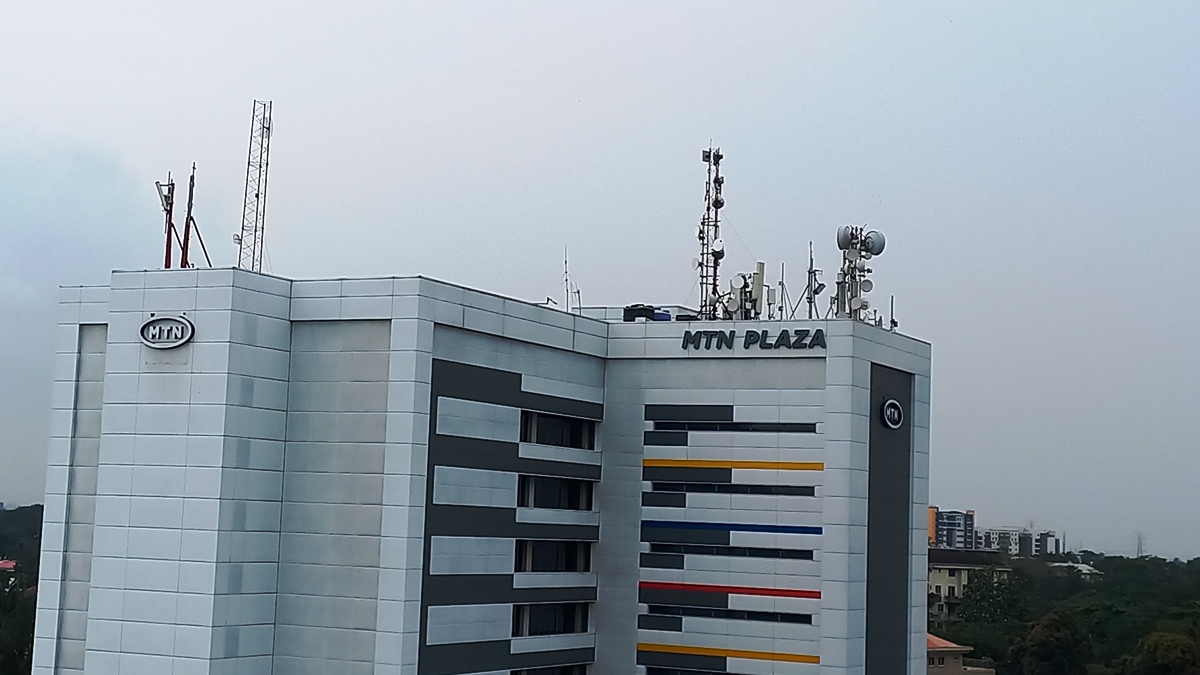
MTN Nigeria’s 25-year record is, by most objective measures, an extraordinary achievement. The operator arrived in a country where most people had never made a phone call, and built a network that today connects 89.5 million subscribers, processes trillions of naira in financial transactions, hosts millions of broadband connections, and serves as the invisible infrastructure for an emerging digital economy.
It has contributed hundreds of billions in taxes, trained tens of thousands of students, and physically enabled the connectivity on which Nigeria’s startup ecosystem operates.
It has also been fined the largest regulatory penalty in African telecom history, faced recurring questions about data sovereignty and profit repatriation, navigated foreign exchange crises that turned record revenues into billion-naira losses, and presided over quality of service gaps that continue to frustrate millions of consumers.
The tension between its role as critical national infrastructure and its nature as a foreign-owned, profit-maximising corporation has never been fully resolved.
The next 25 years will be shaped by whether Nigeria can build a regulatory architecture mature enough to extract maximum public value from MTN’s infrastructure without deterring the capital investment the country urgently needs.
For MTN, the question is whether it can transition credibly from a mobile network operator to a digital platform company, deploying MoMo, cloud, enterprise IoT, and 5G in ways that deepen inclusion rather than simply deepen margins.
The first call was made on May 16, 2001. The conversation, in many respects, is still ongoing.