
The recent telecommunications service disruptions in Nigeria’s capital have opened a critical dialogue on the future of regulatory oversight and the technical health of the nation’s networks.
While immediate operational hurdles such as energy supply, remain a priority, industry experts at Enextgen Wireless are advocating for a more proactive, data-driven approach to ensure a superior “Quality of Experience (QOE)” for all subscribers.
Navigating the Energy-Connectivity Nexus
The Nigerian Communications Commission (NCC) recently identified disruptions in diesel supply by the National Oil and Gas Suppliers Association (NOGASA) as a primary cause of service outages in Abuja.
These bottlenecks have significantly impacted colocation providers like IHS Nigeria, which powers essential base stations for major Mobile Network Operators (MNOs).
To mitigate such vulnerabilities in the future, Enextgen suggests that the industry should accelerate the transition to sustainable energy solutions, such as solar and hybrid systems, reducing the dependency on volatile fossil fuel supply chains.
In a recent EMETRICS analysis, Enexgten Wireless reported:
“Our understanding is that the NCC’s mandate is to regulate telecommunication services, through spectrum licensing and other means. NCC has the authority to regulate all aspects of telecommunications services, and hold service providers accountable for the quality of their networks/services.
In reality, it often appears that NCC goes out of its way to protect telecom services providers. NCC can be more effective in meeting its mandates for high quality of experience in mobile networks by allowing/encouraging the MNOs to be more accountable for the quality of their networks.
The MNOs are commercial businesses. NCC should let them breathe, not smother them with love. NCC should be less dedicated to making excuses for them. Instead, NCC should facilitate their ability to provide the best quality of experience obtainable with their deployed infrastructure, and penalize them for inattention to quality issues. Our platform/service makes this far easier to accomplish”
Beyond Crisis Management: Moving Toward Proactive Accountability
Current analysis suggests that while the NCC’s efforts to facilitate stakeholder dialogue are valuable, there is a strategic opportunity to evolve the regulatory framework. Rather than managing issues after they occur, an advisory approach emphasizes:
- Empowering Market Discipline: Allowing commercial MNOs to take greater direct accountability for network quality can foster a more competitive and self-correcting market.
- Performance-Based Oversight: Encouraging the best possible experience from existing infrastructure while maintaining clear penalties for avoidable inattention to quality issues.
- Transparency in Reporting: Bridging the gap in shared Key Performance Indicators (KPIs) to ensure that technical standards keep pace with technology rollouts like 5G.
The Role of Independent Verification
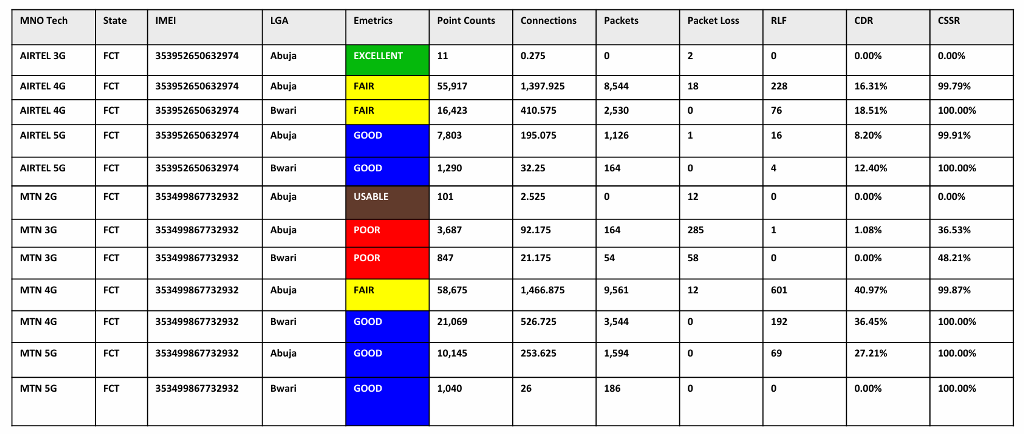
Technical data logged in early December 2025 highlights specific areas where network optimization is needed.
For instance, reports indicate high connection drop rates across both 4G and 5G networks in Abuja , with MTN showing a drop rate nearly double that of Airtel in certain 4G segments.
The table below shows average EMETRICS ranking of coverage signal as the probe transversed local government areas:
Enextgen Wireless also pledged its readiness to work with the NCC as an independent verification and monitoring systems to offer a complementary infrastructure that can:
- Identify Avoidable Drops: Pinpoint RF optimization issues before they lead to customer complaints.
- Enhance Spectrum Efficiency: Unobtrusively improve signal quality, which unwittingly leads to better revenue generation for operators through more efficient spectrum use.
- Optimize 5G Transitions: Manage the “Quality of Experience” as users move between 5G, 4G, and 3G to prevent substantial increases in packet loss and latency.
“The goal for 2026 is a telecom ecosystem where the regulator and operators work in a complementary fashion.
“By integrating independent technical analysis into the national monitoring strategy, the NCC can shift from a reactive “defense” of the industry to a proactive ‘facilitation’ of excellence”, Engr. Aderemi Adeyeye, the president/CEO of Enext Inc., affirmed.
For the Abuja subscriber, the path to reliable connectivity lies in this balance of robust infrastructure, independent data verification, and a regulatory environment that prioritizes the end-user’s daily experience.