

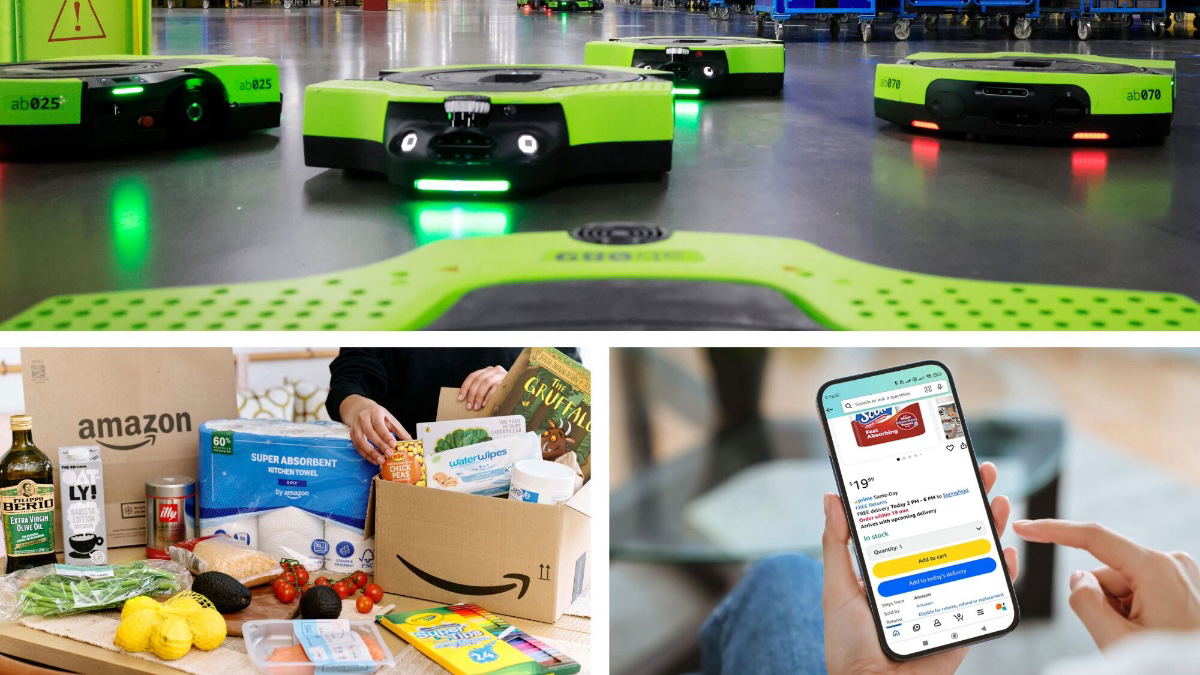
Amazon has expanded its European operations, combining new warehouse robots, faster delivery services and fresh investment in employee training.
The company revealed the plans at its Delivering the Future event in Dartford, England, where it also introduced an upgraded version of Proteus, its autonomous warehouse robot.
The new Proteus can move across warehouse floors rather than being limited to loading and dock areas. Amazon said employees can now give the robot instructions using everyday language instead of technical commands.
“You tell it what needs to be done. It figures out the priority, the route, the timing,” said Scott Dresser, vice president of Amazon Robotics.
Like the current version, Proteus is designed to handle physically demanding work, including moving heavy carts over long distances. Amazon explained that the upgraded robot is being tested in its laboratories and is expected to begin operating in Europe during the first half of 2027.
Alongside Proteus, Amazon also highlighted other robotics technologies that it plans to expand across its European network. These include Vulcan, the company’s first robot with a sense of touch, and STARK, a robotic tote-handling system that works alongside employees by picking full totes from conveyors and placing them onto carts.
STARK was first tested in Barcelona and Amazon plans to deploy it at 15 sites across Europe by 2027.
The warehouse robots rollout is part of an investment programme worth more than €10 billion, Amazon said the funding will be used to expand and modernise fulfilment centres across Europe while supporting long-term growth in the region.
The company expects the expansion to create 25,000 additional jobs across its European fulfilment network over the coming years.
Amazon also announced a fresh commitment to workforce development, pledging $1 billion to its Career Choice programme by 2030. The initiative funds education and training for employees seeking careers in areas such as cyber security, software development, logistics, renewable energy and mechatronics.
More than 300,000 employees have participated in the programme globally, including 30,000 in the United Kingdom.
On the delivery side, Amazon said it will open more than 25 Sub Same-Day Delivery sites across Europe this year. The facilities bring storage, fulfilment and final delivery operations together in one location, allowing customers to place orders later in the day and still receive them within hours.
The company said the network will expand to locations including Coventry in the UK and Nürnberg in Germany.
Amazon Now, the retailer’s ultra-fast delivery service for groceries and household essentials, is also set for further growth. The service, which promises delivery in 30 minutes or less, is already available in parts of London and will expand to Manchester and Birmingham later this year.
In another update for European customers, Amazon said its Add to Delivery feature will launch in the UK, Germany, Spain, Italy and France later this year. The service allows Prime members to add items to an existing order without completing a separate checkout process or paying extra delivery charges.
The company is also strengthening its grocery offering. Customers in parts of central and east London can now combine fresh food items, including fruit, vegetables, meat and dairy products, with other Amazon purchases for same-day delivery.
Amazon said the investment drive follows a record year in Europe. The company invested more than €60 billion across the region in 2025, its largest annual investment in Europe to date.
The retailer also provided an update on its sustainability efforts, revealing that more than 50,000 electric delivery vans are now operating across the United States, Europe and India. That figure represents half of Amazon’s target to deploy 100,000 electric vans globally by 2030.
In Europe, Amazon and its delivery partners have now completed more than 100 million deliveries using electric cargo bikes, electric mopeds and on-foot delivery methods. These deliveries have helped avoid more than 17,000 metric tonnes of carbon emissions.