



Nigeria processes billions of digital payment transactions every year. Yet, for many users, a single failed transaction is enough to push them back to cash, not because fintech isn’t available, but because the experience isn’t built for them.
A recent survey highlights that 84% of Nigerians who used digital financial services experienced at least one problem, such as network failures, unclear fees, or fraud, in just one year.
These are not abstract issues; they directly influence everyday decisions; When a trader tries to pay a supplier, but the app fails, that moment becomes a trust break.
When fees appear that weren’t clearly communicated, users feel cheated. When fraud happens, even if rare, it amplifies fear over future digital use.
A 2022 survey showed that fear of fraud remained one of the top reasons Nigerians hesitate to use digital financial services.
Even when fraud rates aren’t high, perception drives behaviour. If users feel unsafe, they’ll avoid the app.
This is a UI problem; if users received clearer, context-rich feedback from the interface about security steps, they’d feel more confident.
From a mobile and web engineering perspective, many trust issues in Nigerian fintech apps are not caused by system failures, but by how those failures are communicated to users.
In low-bandwidth environments, delayed responses, silent timeouts, or generic error messages leave users unsure whether a transaction succeeded or failed.
That uncertainty is interpreted as unreliability. In practice, simple front-end decisions, such as explicit transaction states, clear retry options, and visible confirmations, can significantly improve user confidence, even when network conditions are imperfect.
Security in fintech is often treated as a backend concern, but for users, it is experienced almost entirely through the interface.
In many Nigerian fintech apps, authentication prompts, warnings, and security notifications are presented without context, using technical language that assumes digital fluency.

From an engineering standpoint, this is a missed opportunity. Front-end teams can design security flows that educate and reassure users in real time, explaining why an extra step is required, what it protects, and what to expect next.
When security actions feel understandable rather than intimidating, users are far more likely to trust and continue using the platform.
Nigerian fintech companies must treat front-end clarity and performance as core financial infrastructure. In environments with unstable connectivity, users judge reliability by how clearly an application communicates transaction states, errors, and confirmations.
Clear feedback, predictable flows, and performance-aware interfaces can restore trust even when systems are under strain.
Also, Security should not feel like a threat to users. Fintech platforms should design authentication and security flows that explain, in simple language, why a step is required and what protection it offers. When users understand security actions, they are more likely to trust and continue using digital financial services.
Beyond technology, Nigeria’s fintech growth depends on people. Investing in mentorship that equips front-end engineers with skills in accessibility, security UX, and human-centric design will raise the overall quality of fintech experiences across the ecosystem. Trust scales when builders are trained to design for real users, not ideal conditions.
Human-centric fintech isn’t about flashy screens; it’s about reducing friction, clarifying every user interaction, and building reliability into every tap.
In Nigeria’s cash-rich ecosystem, every unclear message or network timeout isn’t just a UI bug; it’s a blow to trust.
The stakes are high: as digital financial services expand, millions of users are forming lifelong habits that will determine whether Nigeria achieves true financial inclusion.
Companies, engineers, and regulators must act now, prioritising clear, reliable, and trustworthy interfaces, investing in developer mentorship, and designing security flows that educate rather than intimidate.
Only by putting humans at the centre of every click, tap, and swipe can Nigeria’s fintech ecosystem reach its full potential and transform the way people access and trust financial services.
About the author:
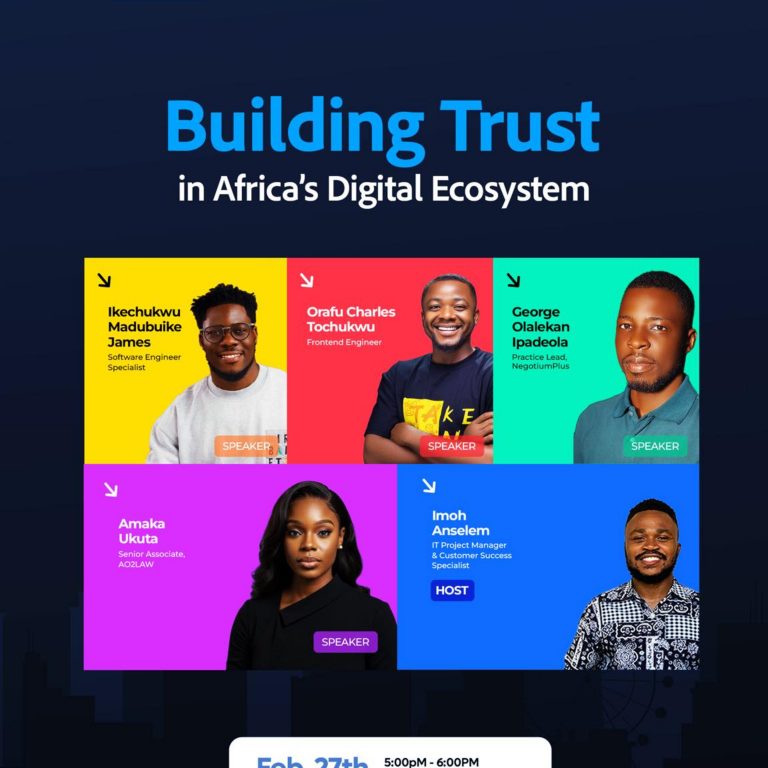
Charles Orafu is a software engineer with over 4 years of experience building web and mobile applications. Passionate about creating reliable, user focused digital products.