

ADVERTISEMENT
Saturday, April 25, 2026
Tech | Business | Economy
No Result
View All Result
  • Technology
    • Trends
    • Telecoms
      • Broadband
    • ConsumerTech
      • Gadgets and Appliances
      • Apps
      • Accessories
      • Reviews
      • Unboxing
    • EnterpriseTECH
    • Security & Data Protection
    • How To
    • GameTech
  • Business
    • Company News
    • StartUPs
      • Founder’s Story
      • Funding
    • Deals
    • People & Moves
    • SME & Entrepreneur Focus
    • BUSINESS SENSE FOR SMEs
    • Competition & Market Positioning
    • Commerce & Mobility
    • Travel
    • WomenPreneurs
  • Economy
    • Macroeconomic Trends
      • Macro Monday
      • TE Insights
    • Finance
      • Banks
      • Fintech
      • Insurance
      • Digital Assets
      • Personal Finance
    • Policies
      • Tech & Society
    • Market Analysis
    • Jobs & Workforce Economy
  • Features
    • Guest Writer
      • Chidiverse
      • Digital Assets
    • EventDIARY
    • IndustryINFLUENCERS
    • MarkTECH
    • TBS
    • NewsEXTRA
  • Editorial
  • Brand Content
  • TECHECONOMY TV
Saturday, April 25, 2026
Tech | Business | Economy
No Result
View All Result
Tech | Business | Economy
No Result
View All Result

Home » Africa’s Economic Future Depends on Its Compute Capacity – Kashifu Inuwa

Africa’s Economic Future Depends on Its Compute Capacity – Kashifu Inuwa

Joan Aimuengheuwa by Joan Aimuengheuwa
November 1, 2025
in Company News
Reading Time: 3 mins read
3
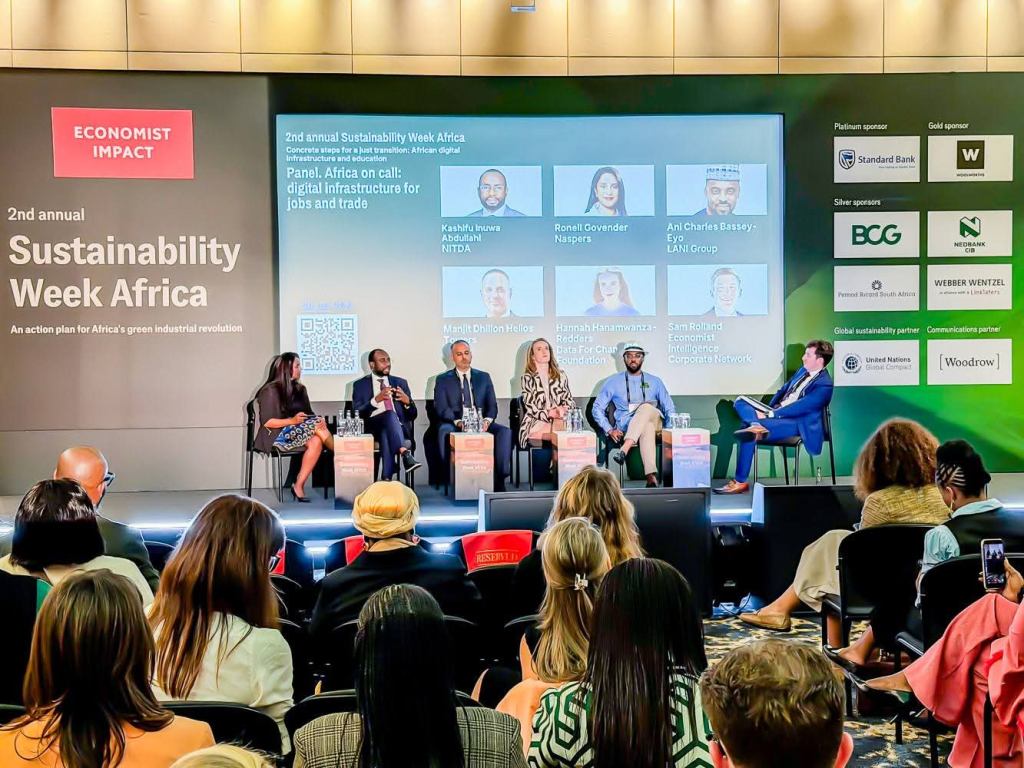
Kashifu Inuwa Abdullahi, the DG of NITDA speaking on Tech in Africa

Kashifu Inuwa, DG of NITDA (2nd left) joined by others to discuss the transition of the African digital infrastructure for jobs and trade. They are; Ronell Govender of Naspers; Ani Charles Bassey-Eyo of LANI Group; Manjit Dhillon Helios of Towers; Hannah Hanawanza-Redders of Data for Change Foundation; and Sam Rolland of Economist Intelligence Corporate Network

Africa’s path to economic independence lies in building its own compute capacity, according to Kashifu Inuwa, director general of the National Information Technology Development Agency (NITDA), who emphasized that digital infrastructure is the cornerstone of transformation, employment, and regional trade.

He stresses that a forceful investment in local digital public infrastructure is the critical step to unlock sustainable transformation and finally drive meaningful economic growth across the continent.

The DG made this known at the 2nd annual Sustainability Week Africa, which was held at The Westin in Cape Town, South Africa, where he shared insights into how leveraging technologies can accelerate the transition to a greener economy.

Sustainability Week Africa is a continental platform that showcases practical ways for governments, businesses, and communities to embrace green growth, with the 2025 edition focusing on Africa’s role in driving energy transition, climate resilience, and sustainable development.

Speaking during a panel session on Digital Infrastructure for Jobs and Trade in Africa, Inuwa emphasised the urgent need for Africa to develop its own computing infrastructure to achieve digital independence and competitiveness in the global economy.

Subscribe to our Telegram channel for the latest updates.

Follow the latest developments with instant alerts on breaking news, top stories, and trending headlines.

Join Channel

He noted that while Africa can leverage artificial intelligence (AI) to leapfrog development, it must also build the computing capacity required to sustain innovation.

“In the 21st century, compute power is a primary factor of production, and we cannot rely on exporting our raw data to other regions to process it and build products for us,” he averred.

Drawing parallels with Europe’s collaborative approach to developing high-performance supercomputers and AI factories, the DG urged African governments to adopt similar models by creating policy incentives that attract private sector investment in digital infrastructure.

He explained that digital public infrastructure (DPI) operates at two levels: the shared physical and technical infrastructure, such as connectivity and cloud capacity; and the functional layer, digital identity, payment systems, and data exchange platforms, that enable citizens and businesses to access services seamlessly.

Citing Nigeria’s progress, the NITDA DG disclosed that more than 130 million Nigerians have been enrolled under the national digital identity system, while efforts are underway to establish a national data exchange platform and a DPI Centre of Excellence to promote interoperability and best practices across all tiers of government.

He added that such initiatives could serve as a model for other African countries, advocating for an “African-built DPI” that reflects local needs rather than imported systems.

“The Minister of Communications, Innovation, and Digital Economy in Nigeria, Dr Bosun Tijani, is leading and pushing for establishing a DPI centre of excellence, where we can have people building the actual DPI data exchange well, building APIs, and also coming up with best practices,” he disclosed.

On digital literacy, Inuwa reiterated Nigeria’s commitment to achieving 95% digital literacy by 2030 and 70% by 2027, under the National Digital Literacy Framework.

He noted that digital skills have now become mandatory for students and civil servants, through partnerships with organisations such as Cisco and the NYSC to train youth, women, and market traders on how to use digital tools and AI-powered applications to expand economic opportunities.

The NITDA boss called for clear policy frameworks to guide AI adoption and technology development across Africa, describing digital transformation not as a sector, but as an enabler for every sector of the economy.

“In Africa, we need to have our digital circuits by building our own capacity for digital self-determination. We should not rely on other countries to be sending hardware and software to us because our goal is to build a better life for our citizens, and technology will help us achieve that,” he noted.

He concluded by calling for stronger coordination between governments, the private sector, and development partners to harmonise digital standards and scale innovation across the continent.

He said, “Africa’s advantage lies in our ability to leap, to build collaboratively, and to design technology for inclusion. If we build the digital rails together, our youth will drive Africa straight into the heart of the global digital economy.”

0Shares

Previous Post

Naira Stages Rally to ₦1,421/US$

Next Post

George Agu to Lead Discussions at Afritech 5.0

Joan Aimuengheuwa

Joan Aimuengheuwa

Joan thrives at helping individuals and businesses scale via storytelling...

Related Posts

rof. Chiso Ndukwe-Okafor, CADEF’s executive director | Sugar Content

CADEF, Stakeholders Push for Zero Added Sugar Standards in Infant Foods

April 24, 2026
Nweze Ikechukwu: OliliFood Rebrands to Trazo

Nweze Ikechukwu’s Delivery Platform OliliFood Rebrands to Trazo

April 24, 2026

NITDA Saves FG ₦319bn in 2025 after Reviewing ₦1.5tn IT Projects across MDAs

April 23, 2026
Load More
Next Post
George Agu - AfriTECH 5.0

George Agu to Lead Discussions at Afritech 5.0

Comments 3

  1. Pingback: Africa’s Economic Future Depends on Its Compute Capacity – Kashifu Inuwa | Tech | Business – Nigeria News Update
  2. Pingback: Nigeria Becomes First West African Host of UN Digital Governance Conference ICEGOV 2025 – Nigeria News Update
  3. Pingback: Nigeria Becomes First West African Host of UN Digital Governance Conference ICEGOV 2025

Leave a Reply Cancel reply

Your email address will not be published. Required fields are marked *

I agree to the Terms & Conditions and Privacy Policy.

This site uses Akismet to reduce spam. Learn how your comment data is processed.

Techeconomy Podcast
Techeconomy Podcast

The Techeconomy Podcast is a thought-leadership show exploring the powerful intersection of technology, business, and the economy, with a strong focus on Africa’s fast-evolving digital landscape.

BUILDING TRUST IN AFRICA ECOSYSTEM
byTecheconomy

Africa’s digital economy is growing fast, but growth without trust cannot last.Join us for the February Edition of the Techeconomy Business Series as industry experts explore how trust, security, innovation, and user experience are shaping Africa’s evolving digital ecosystem.

BUILDING TRUST IN AFRICA ECOSYSTEM
February 27, 2026
Techeconomy
Navigating a Career in Tech Sales
January 29, 2026
Techeconomy
How Technology is Transforming Education, Health, and Business
November 27, 2025
Techeconomy
INNOVATION IN MOBILE BANKING
October 30, 2025
Techeconomy
The Rise of AI: Impact on Jobs & Businesses
September 25, 2025
Techeconomy
Search Results placeholder
  • About Us
  • Careers
  • Contact Us
  • Privacy Policy

© 2026 TECHECONOMY.

No Result
View All Result
  • Technology
  • Business
  • Economy
  • Features
  • Editorial
  • Brand Content
  • TECHECONOMY TV

© 2026 TECHECONOMY.

This website uses cookies. By continuing to use this website you are giving consent to cookies being used. Visit our Privacy and Cookie Policy.


