May 2026 was largely dominated by flagship smartphones. While Google focused attention on its Android Show and I/O 2026 event, many major Android brands spent the month competing in the premium market.
This was quite different from March and April, when the spotlight was mainly on affordable smartphones.
Devices like the Redmi A7 and Apple’s surprise iPhone 17e helped push conversations around capable entry-level phones earlier this year.
But in Nigeria and across much of sub-Saharan Africa, the meaning of a “budget smartphone” is very different from what global brands usually advertise.
In markets like Europe or North America, a $300 phone may still be considered affordable. In Nigeria however, where factors like low standard of living, high import cost and over-dependence on foreign tech shape buying decisions daily, the true budget category sits much lower.
For most buyers, anything around or below $180 (less than N250K) is quite affordable. Meanwhile May still delivered a few phones in this category.
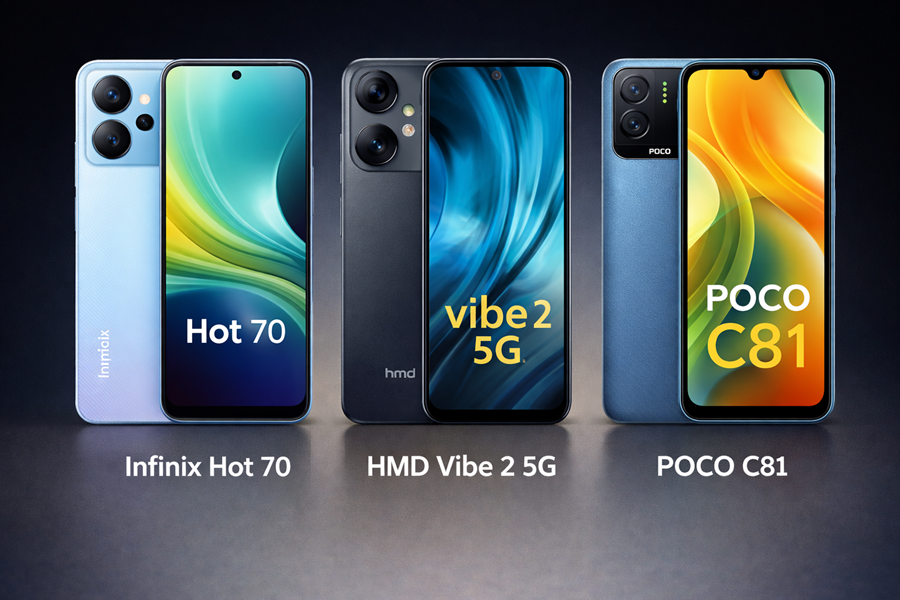
Here are the most interesting launches or releases made available in May 2026, starting with the most recent release from Infinix.
1. Infinix Hot 70
Among the latest smartphones released this month, the Infinix Hot 70 stands out the most because it understands what many budget buyers in Africa prioritise in 2026: battery life, screen size and affordability.
Rather than following premium AI marketing trends, Infinix focused on practical improvements that matter most to everyday users.
Specifications
- 78-inch HD+ display with 120Hz refresh rate
- Large 6000mAh battery
- 45W fast charging support
- MediaTek Helio G100 processor
- Android 16 out of the box
- Side-mounted fingerprint scanner
- Dual rear camera setup (50MP) with 8MP front camera
- Expanded RAM support via memory fusion
- USB-C connectivity
- 4G LTE network support
The main strength of this phone is its endurance. For Nigerians, this phone is great for a full day’s use. The battery combined with a powerful processor that beats Samsung’s A07 should be comfortable enough for most tasks from social media to light gaming.
The biggest compromise is most likely performance consistency under heavy use. Unlike Samsung’s A07 series, the Infinix Hot 70 still lacks software optimisation for longevity.
For now, the Infinix Hot 70 is not yet officially available in Nigeria. However, that situation is unlikely to last long. Nigeria still remains one of the biggest markets for Transsion brands globally, and new Infinix devices usually arrive locally within days or a week after announcement.
2. HMD Vibe 2 5G
HMD’s smartphone strategy in 2026 looks completely different from what most competing brands are doing in Africa.
While others like TECNO and Infinix focus on packing flashy features into budget smartphones, HMD seems to follow Samsung’s strategy of balancing software, design and longevity.
Specifications
- 5G network support
- Near-stock Android experience
- 6000mAh battery with 18W charging speed
- HD+ display with 120Hz fresh rate
- Unisoc T8200 (6 nm) chipset
- 6GB RAM/128GB ROM with expandable storage support
- USB-C charging
- 50MP dual camera system with 8MP front camera
- Side fingerprint scanner
- Android 16 (Upgradable for 2 years)
The main advantage of this device is software simplicity. Many budget Android phones in 2026 still come with bloatware ads and aggressive UI customisation.
HMD avoids this approach, delivering a clean Android experience. This makes the phone feel premium even though it comes with modest hardware. The inclusion of 5G is also a great advantage, even though 5G connectivity is not widespread yet.
Compared to the Infinix Hot 70, it offers:
- Cleaner software
- Better performance stability
- More reliable multitasking
- 5G support
- Less system bloat
Meanwhile, Infinix still wins when it comes to:
- Charging speed
- Offline availability
- Bigger display appeal
- Accessory ecosystem in Nigeria
3. POCO C81
Although the POCO C81 actually launched on April 27th, the device became widely available in Nigeria around early May, placing it directly within this conversation.
With this device, POCO continues to target a younger Android audience, who are more concerned about performance value than brand familiarity.
Specifications
- Large HD+ display with 120Hz refresh rate
- Unisoc T7250 processor
- 6,300mAh battery with 18W fast charging
- Android 16 with the latest HyperOS skin
- 50MP main camera and 8MP front camera
- Available in 4GB RAM/ 64GB ROM or 6GB RAM/ 128GB ROM variants
- Side-mounted fingerprint scanner
Performance is the main reason to consider this device. POCO devices are known to prioritise chipset capability more aggressively than many other competitors in the same price range, and that trend continues here. For gaming, multitasking and app switching, the C81 could outperform several similarly priced alternatives released this year.
POCO’s software ecosystem has also improved significantly over the past two years, although HyperOS remains heavier than HMD’s cleaner Android implementation.
The downside of the POCO C81 in Nigeria is its visibility and support. Unlike Infinix, TECNO or Samsung, POCO still lacks offline retail penetration in Nigeria. Repairs, accessories and after-sales service are not yet as widespread, even though it is a sub-brand of Xiaomi.
May 2026 may have been dominated by premium phones, but the budget market still produced a few devices suitable for emerging markets.
For Nigerians especially, these phones solve specific local problems like power supply, affordability and connectivity, and this trend is less likely to slow down anytime soon. June could bring more interesting budget smartphones, like the Samsung Galaxy A27.