

ADVERTISEMENT
Monday, June 1, 2026
Tech | Business | Economy
No Result
View All Result
  • Technology
    • Trends
    • Telecoms
      • Broadband
    • ConsumerTech
      • Gadgets and Appliances
      • Apps
      • Accessories
      • Reviews
      • Unboxing
    • EnterpriseTECH
    • Security & Data Protection
    • How To
  • Business
    • Company News
    • StartUPs
      • Founder’s Story
      • Funding
    • Deals
    • People & Moves
    • SME & Entrepreneur Focus
    • BUSINESS SENSE FOR SMEs
    • Competition & Market Positioning
    • Commerce & Mobility
    • Travel
    • WomenPreneurs
  • Economy
    • Macroeconomic Trends
      • Macro Monday
      • TE Insights
    • Finance
      • Banks
      • Fintech
      • Insurance
      • Digital Assets
      • Personal Finance
    • Policies
      • Tech & Society
    • Market Analysis
    • Jobs & Workforce Economy
  • Features
    • Guest Writer
      • Chidiverse
      • Digital Assets
      • GameTech
    • EventDIARY
    • IndustryINFLUENCERS
    • MarkTECH
    • TBS
    • NewsEXTRA
  • Editorial
  • Brand Content
  • TECHECONOMY TV
Monday, June 1, 2026
Tech | Business | Economy
No Result
View All Result
Tech | Business | Economy
No Result
View All Result

Home » List of Harmonized Short Codes Approved by NCC

List of Harmonized Short Codes Approved by NCC

Peter Oluka by Peter Oluka
March 14, 2023
in Telecoms
Reading Time: 2 mins read
0
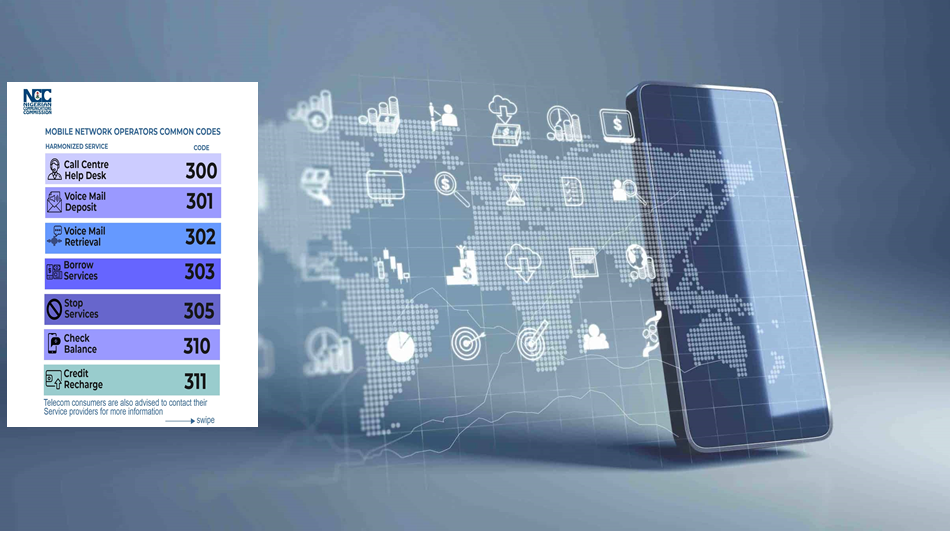
List of Short codes approved by NCC

List of VAS Short codes approved by NCC

  • directs implementation

In line with its consumer-centric approach to telecoms regulation, the Nigerian Communications Commission (NCC) has directed mobile network operators (MNOs) to commence implementation of approved harmonised short codes (HSC) for providing certain services to telecom consumers in Nigeria.

The Commission has already set a deadline of May 17, 2023, for all mobile networks to fully migrate from hitherto diverse short codes to the harmonised codes.

The use of harmonised short codes is aimed at achieving uniformity in common short codes across networks. This means that the code for checking airtime balance is the same across all mobile networks for the same function, irrespective of the network a consumer uses.

According to a press statement signed by Reuben Muoka, Director, Public Affairs, NCC, with the new codes, the telecom consumers using the over 226 million active mobile lines in the country, can now use the same codes to access services across the networks.

Consequently, under the new harmonised short codes regime, 13 common short codes have been approved by the Commission.

Subscribe to our Telegram channel for the latest updates.

Follow the latest developments with instant alerts on breaking news, top stories, and trending headlines.

Join Channel

They include the following codes: 300 to be used as the harmonised code for Call Centre/Help Desk on all mobile networks; 301 for voice Mail Deposit; 302 for Voice Mail Retrieval; 303 for Borrow Services; 305 for STOP Service; 310 for Check Balance, and 311 for Credit Recharge.
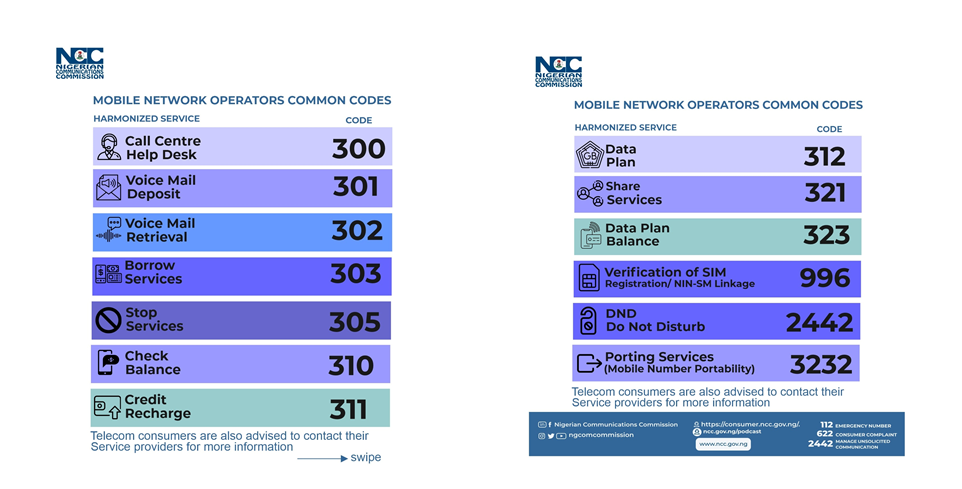
NCC approves harmonised short codes for MNOs

Also, the common code for Data Plan across networks is now 312. In line with the new direction, 321 is for Share Services, while 323 is for Data Plan Balance. The code, 996, is now for Verification of Subscriber Identity Module (SIM) Registration/NIN-SIM Linkage. The code, 2442, is retained for Do-Not-Disturb (DND) unsolicited messaging complaint management, while the common code, 3232, is also retained for Porting Services, otherwise called Mobile Number Portability.

The old and new harmonised short codes will run concurrently up until the May 17, 2023, when all networks are expected to have fully migrated to full implementation of the new codes.  The period between now and May 17, 2023 is provided by the NCC to enable telecom consumers to familiarise themselves with the new codes for various services.

The initiative, which is in line with NCC’s regulatory modernisation programme, is essentially to make life much easier for telecom consumers, as it is now easier for Nigerians to memorise single codes for various services across all mobile networks they may be using, thereby improving consumer quality of experience (QoE).

In addition, the new policy will provide opportunity for licensees in the Value-Added Services (VAS) segment of the telecoms sector to be able to use freed-up/old codes for other services, as well as enhance cohesive regulatory framework in keeping with world-class practices.

0Shares
MTN Live It 100 Thematic Campaign
Previous Post

Development Banks Back Funding Scheme for Nigeria’s Digital, Creative Sectors

Next Post

Y Combinator Cutoff 17 Staff as it Takes Out Late-Stage Investment

Peter Oluka

Peter Oluka

Peter Oluka (@peterolukai), editor of Techeconomy, is a multi-award winner practicing Journalist. Peter’s media practice cuts across Media Relations | Marketing| Advertising, other Communications interests. Contact: peter.oluka@techeconomy.ng

Related Posts

Vertiv CoolChip CDU2300 solution

Vertiv Targets AI Boom with EMEA Liquid Cooling Launch 

May 30, 2026
facts behind the sustrainability | MTN Nigeria greenhouse gas emissions

MTN Nigeria Sets Telecom Sector Benchmark for Sustainability Reporting 

May 30, 2026

Vertiv Enables OADC to Scale AI, Hyperscale Workloads at Jo’burg Data Centre

May 30, 2026
Load More
Next Post
Y Combinator Cutoff 17 Staff as it Takes Out Late-Stage Investment

Y Combinator Cutoff 17 Staff as it Takes Out Late-Stage Investment

Leave a Reply Cancel reply

Your email address will not be published. Required fields are marked *

I agree to the Terms & Conditions and Privacy Policy.

This site uses Akismet to reduce spam. Learn how your comment data is processed.

Techeconomy Podcast
Techeconomy Podcast

The Techeconomy Podcast is a thought-leadership show exploring the powerful intersection of technology, business, and the economy, with a strong focus on Africa’s fast-evolving digital landscape.

Financing the Future: Venture Debt, Local Capital & African Innovation | TBS May 2026 Webinar
byTecheconomy

Africa’s innovation ecosystem is evolving, but where will the funding for the next generation of startups come from?

In this edition of the Techeconomy Business Series (TBS) May 2026, industry experts explore how local capital, venture debt, and smarter investment structures are redefining startup growth and innovation across Africa.

🎙️ Featured Speakers:

* Ebunoluwa Ashley-Dejo

* Damilare Davola

* Success Ajilore (STN & Accelerated Plus)

Key conversations in this webinar include:

✔️ The future of startup financing in Africa

✔️ Venture debt and alternative funding models

✔️ The role of local investors in scaling innovation

✔️ Sustainable investment strategies for African startups

✔️ Opportunities and challenges in the African tech ecosystem

Subscribe for more conversations shaping Africa’s digital economy and innovation landscape.

#TBS2026 #AfricanInnovation #VentureDebt #StartupFinance #TechInAfrica #Techeconomy #AfricanStartups #InnovationEconomy

Financing the Future: Venture Debt, Local Capital & African Innovation | TBS May 2026 Webinar
May 27, 2026
Techeconomy
PROTECTING INNOVATION IN AFRICA’S STARTUP ECOSYSTEM
April 29, 2026
Techeconomy
BUILDING TRUST IN AFRICA ECOSYSTEM
February 27, 2026
Techeconomy
Navigating a Career in Tech Sales
January 29, 2026
Techeconomy
How Technology is Transforming Education, Health, and Business
November 27, 2025
Techeconomy
Search Results placeholder
MTN Live It 100 Thematic Campaign
ADVERTISEMENT
  • About Us
  • Careers
  • Contact Us
  • Privacy Policy

© 2026 TECHECONOMY.

No Result
View All Result
  • Technology
  • Business
  • Economy
  • Features
  • Editorial
  • Brand Content
  • TECHECONOMY TV

© 2026 TECHECONOMY.

This website uses cookies. By continuing to use this website you are giving consent to cookies being used. Visit our Privacy and Cookie Policy.

