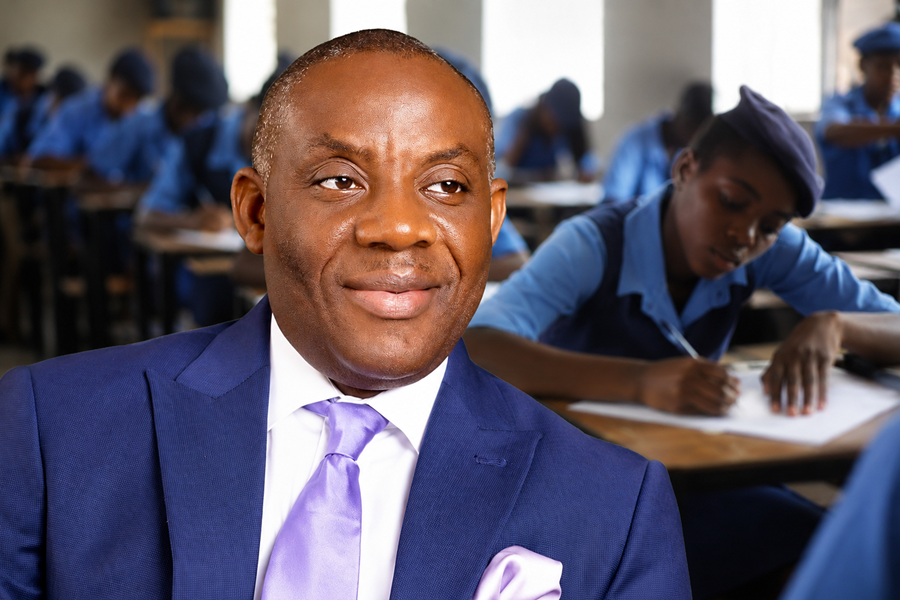
For thousands of Nigerian students, the dream of completing secondary school may soon come with a price tag their families simply cannot afford.
Beginning next year, candidates sitting for the Senior School Certificate Examinations (SSCE) conducted by the West African Examinations Council (WAEC) and the National Examinations Council (NECO) are expected to pay a harmonised fee of N50,000, up from the current N27,000, an increase of more than 85 percent.
While the Federal Government’s decision aims to standardise examination fees following a directive by Dr. Tunji Alausa, the minister of Education, the announcement has ignited widespread criticism from education experts, labour leaders, school administrators and civil society groups, who fear the policy could widen Nigeria’s education gap at a time when millions of households are already struggling with inflation and declining purchasing power.
For many families earning the country’s N70,000 minimum wage, the new examination fee represents almost an entire month’s income for a single child.
Fear of More Out-of-School Children
Education stakeholders argue that beyond the immediate financial burden, the fee increase risks pushing more teenagers out of school and undermining years of efforts to improve access to education.
Dr. Olufemi Mosaku-Johnson, national administrator of the Association of Corporate Governance Professionals of Nigeria, described the increase as ill-timed, warning that brilliant students from low-income households could miss their final secondary school examinations simply because they cannot afford the registration fee.
Although he acknowledged that both WAEC and NECO now operate as self-funding institutions requiring additional resources to deploy technologies such as biometric verification and CCTV surveillance to curb examination malpractice, he insisted that the government should not transfer the full cost to struggling parents.
Instead, he called on federal and state governments to fully sponsor examination fees for students in public secondary schools while increasing overall investment in education.
He also noted that Nigeria’s education funding remains below UNESCO’s recommended benchmark of 15–20 percent of national budgets.
Teachers Warn of Growing Inequality
The Academic Staff Union of Secondary Schools (ASUSS) echoed similar concerns.
Comrade (Dr.) Felix Oluwaseun Agbesanwa, Ogun State chairman of ASUSS and National Public Relations Officer of the union, said the proposed increase comes at one of the most economically difficult periods for Nigerian families.
With transportation costs, food prices and inflation continuing to rise, he warned that many parents, especially those with multiple children, may simply be unable to pay the new fees.
According to him, the consequence could be an increase in school dropouts, examination defaulters and widening educational inequality.
Agbesanwa urged the Federal Government to accompany any fee review with targeted subsidies, scholarship programmes and broader consultations involving teachers, parents, school proprietors and civil society organisations.
Labour, Rights Groups Join Opposition
The Nigeria Labour Congress (NLC) also criticised the policy.
Its spokesperson, Benson Upah, described the increase as “stiff, sudden and unreasonable,” arguing that it fails to reflect the economic realities facing low-income workers whose children make up the majority of WAEC and NECO candidates.
Human rights lawyer Femi Aborisade went further, contending that the decision contradicts Section 18 of the 1999 Constitution, which places responsibility on government to provide access to secondary education.
He argued that terminal examinations should form part of that constitutional guarantee rather than becoming an additional financial barrier.
Parents Fear the Worst
For many school proprietors and parents, the issue extends beyond policy.
Agbo Majekodunmi, who runs a preparatory school for SSCE candidates in Ogun State, recalled how communities and religious organisations often mobilise funds to help indigent students register for WAEC and NECO.
He warned that increasing the fee to N50,000 could leave many students permanently excluded from the education system.
Northern Youths Council of Nigeria representative Isah Abubakar similarly cautioned that higher examination costs could reverse progress in reducing illiteracy by forcing more students to abandon their education before graduation.
Calls for Reversal
The growing opposition has also attracted political attention.
Former Vice President Atiku Abubakar criticised the proposed examination fee alongside recent increases in Federal Unity College fees, describing the measures as economically insensitive and likely to worsen Nigeria’s already significant out-of-school children crisis.
He urged the Federal Government to suspend the policy and instead convene stakeholders to explore sustainable funding models that improve examination quality without restricting access to education.
As the debate continues, one question remains at the centre of the controversy:
Should improving examination standards come at the cost of making secondary education less accessible to the very students it is meant to serve?