



Nigeria’s telecommunications regulator has called for accelerated deployment of Fibre-to-the-Home (FTTH) infrastructure, warning that the country’s ambition to build a $1 trillion economy will depend on robust digital connectivity and sustained investment in broadband networks.
Delivering a keynote address at the Association of Telecommunications Companies of Nigeria (ATCON) High-Level Industry Forum on FTTH in Lagos, Dr. Aminu Maida, the executive vice chairman of the Nigerian Communications Commission (NCC), said fixed fibre broadband remains significantly underdeveloped despite growing demand for high-speed internet driven by artificial intelligence, cloud computing, streaming services and digital businesses.
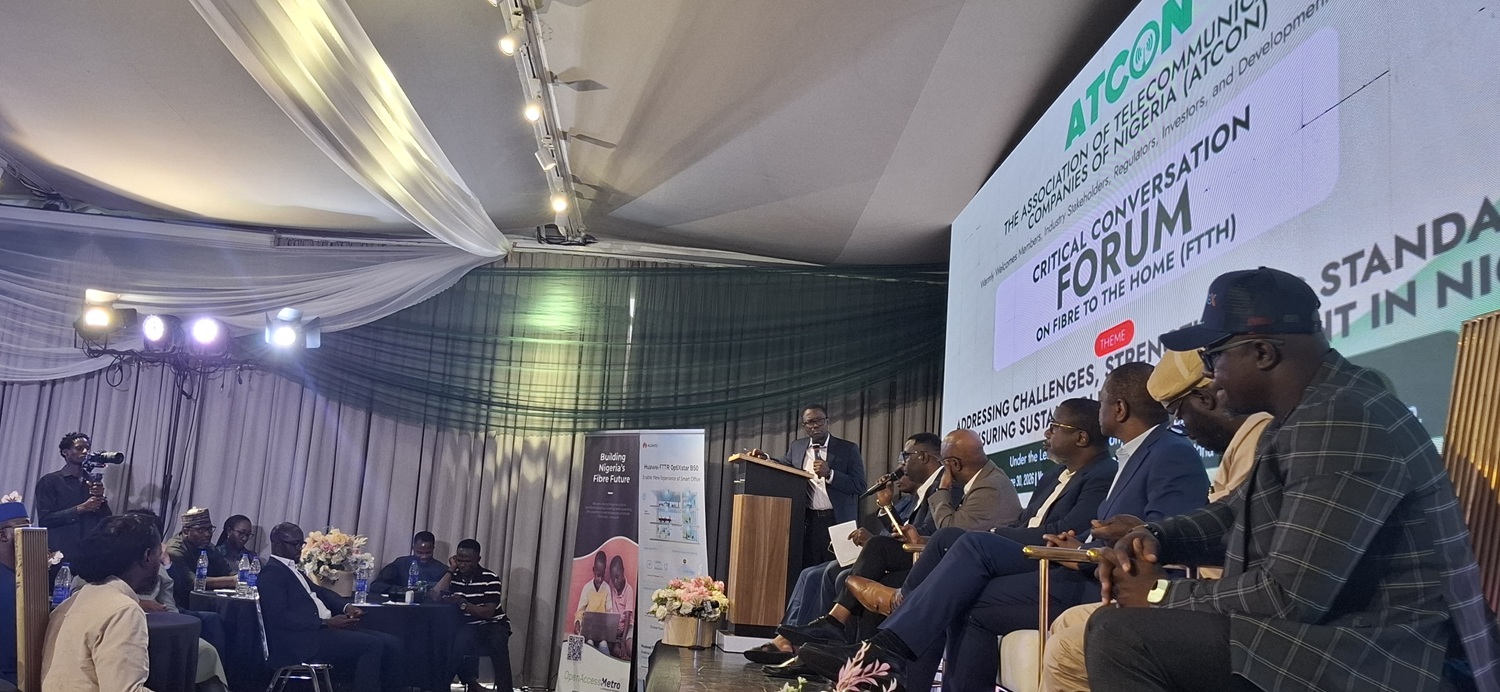
According to Maida, Nigeria currently has about 265,000 active FTTH subscriptions, a penetration level that remains below the African average of 2.5% and far behind the 47% average recorded in more mature broadband markets.
“This low base should not discourage us. It should focus us. It shows the scale of the opportunity before Nigeria and reinforces the need to create the right conditions for fibre infrastructure to expand more rapidly, more sustainably and more widely across the country,” he said.
Maida noted that fibre infrastructure offers the speed, resilience and scalability required to support increasingly data-intensive applications while providing a future-proof platform for successive technology upgrades.
He said improved broadband infrastructure would play a critical role in enhancing business competitiveness, expanding digital services, improving productivity and attracting investment into Nigeria’s digital economy.
To stimulate investment, the NCC disclosed that it is conducting a Wholesale Fixed Broadband Market Assessment aimed at evaluating competition within the wholesale broadband segment and identifying measures to encourage infrastructure investment, promote infrastructure sharing, strengthen open access models and improve affordability for consumers.
The regulator also renewed calls for state governments to remove barriers hindering fibre deployment, identifying Right of Way (RoW) approvals as one of the biggest challenges facing broadband expansion.
Maida said excessive RoW charges, lengthy approval timelines and multiple permitting requirements continue to increase deployment costs and delay network rollout across the country.
He revealed that 13 states have completely waived Right of Way charges, while 16 others have adopted the National Economic Council’s recommended rate of ₦145 per linear metre, adding that the Commission would continue engaging the remaining states to eliminate unnecessary barriers to broadband investment.
To improve transparency for investors and network operators, the NCC has launched an Ease of Doing Business Portal, which provides state-by-state information on Right of Way charges, approval processes, infrastructure deployment data and relevant regulatory requirements.
The Commission also urged governments, property developers and urban planners to integrate telecommunications infrastructure into the planning of new residential and commercial developments rather than treating connectivity as an afterthought.
“Just as new developments make provision for electricity, water and drainage, they should also make provision for telecommunications infrastructure,” Maida said, noting that early fibre planning reduces deployment costs and speeds up service activation.
The NCC further stressed the need to enforce technical and safety standards across fibre deployment projects, warning that poor installation practices, substandard materials and inadequate documentation increase network failures, service disruptions and maintenance costs.
“Our priority is not simply that fibre is deployed quickly, but that it is built to last and capable of supporting Nigeria’s digital ambitions for decades to come,” Maida said.
Industry stakeholders at the forum agreed that expanding fibre infrastructure would be critical to improving broadband penetration, supporting emerging digital technologies and strengthening Nigeria’s position as one of Africa’s leading digital economies.



