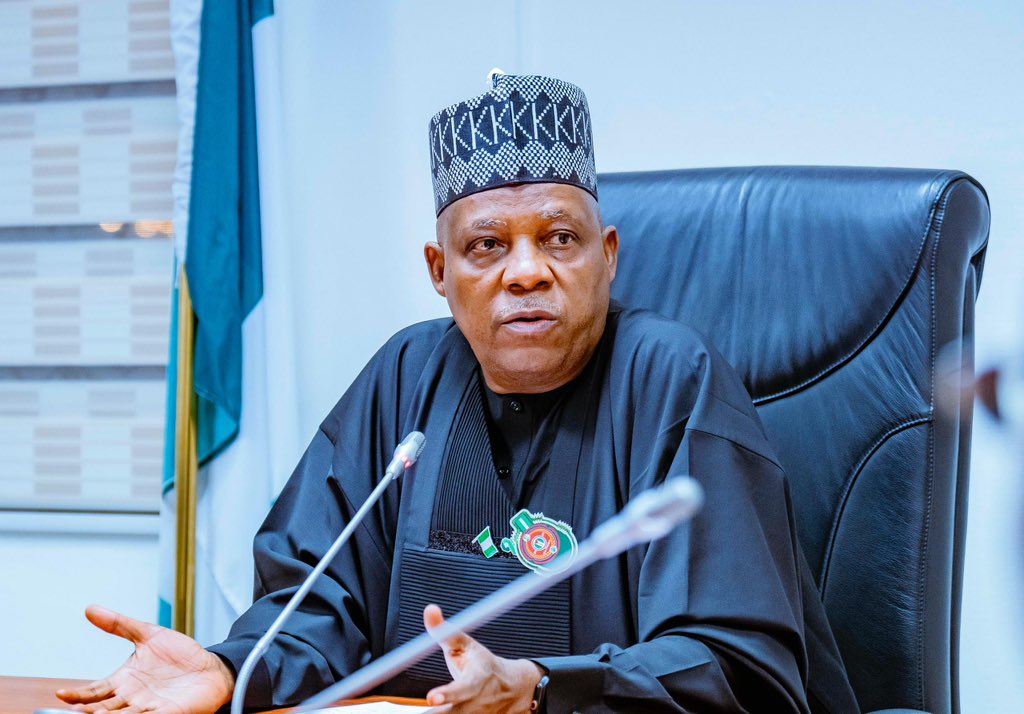
Vice President Kashim Shettima, Tuesday said Nigeria’s debt service-to-revenue ratio decreased sharply from 120 per cent in December 2022 to 68 per cent in 2025 amid ongoing tax reforms introduced by President Bola Tinubu’s administration.
He spoke at the opening of the 2026 Tax Conference with the theme, “Tax Reforms and Global Relevance: Positioning Nigeria’s Tax System for a Sustainable Future” which is organized by the Chartered Institute of Taxation of Nigeria (CITN), in Abuja.
Shettima said the reforms had become a major tool for strengthening government revenues, improving fiscal sustainability and supporting the administration’s ambition of growing the economy to $1 trillion by 2030.
Represented by Dr. Tope Fasua, special adviser to the President on Economic Affairs, the vice president said, “Many pundits have complained about our high revenue to debt servicing ratio. But the only antidote to this anomaly is to drive revenue for the government, based on well-thought-through and properly-established fiscal laws.
“We are on a solid course, as our current tax reforms are the primary engine for this leap and we have been able to close that chasm by bringing down this ratio from a galling high of 120 per cent in December 2022, to 68 per cent as at the close of 2025.”
The vice president said the reforms, which took effect from January 1, 2026, represented Nigeria’s first comprehensive tax overhaul in more than 35 years and were designed to reposition the economy for long-term growth.
He said the federal government was already streamlining tax administration and broadening the tax base to improve the country’s balance sheet and reduce pressure from debt obligations.
Shettima said,
“Every Naira recovered from inefficiency and every kobo brought into the net from previously untapped sectors is a brick in the bridge toward that $1 trillion milestone”, adding that reforms would also help government shift from a “nation that borrows to survive to one that invests to thrive”.
The vice president also stated that the current administration remained determined to “break the shackles of high-interest burdens that stifle our ability to fund education, healthcare, social services and infrastructure”.
He stressed that Tinubu had inaugurated the tax reform committee then headed by Oyedele, shortly after assuming office in May 2023 to address weak revenue generation and widespread informality in the economy.
He described the reforms as part of a broader effort to rebuild public infrastructure and improve Nigeria’s competitiveness globally.
Shettima also defended the reforms against criticism, adding that many Nigerians were unaware of their “pro-poor” provisions, stressing that many Nigerians remained unaware that anyone earning N1 million and below will go tax free in the country.
He said,
“Some simply cannot believe that small businesses turning over N100 million and below every year are totally tax exempt.”
The vice president however added, “But it is not yet uhuru. We face daunting challenges in our quest for a new, greater Nigeria. The innards of the tax reform must be disseminated far and wide. Many Nigerians are yet unaware, even of the pro-poor nature of the reforms and how it favours the underprivileged amongst us.
“Many Nigerians don’t know that anyone earning N1 million and below will go tax free in Nigeria. Some simply cannot believe – because it has never happened before – that small businesses turning over N100 million and below every year are totally tax exempt. They must be constantly reminded that President Tinubu is not anti-people or anti-business, but pro-people and pro-business.
“He wants Nigerians to thrive and succeed, and we shall work to ensure this. Information dissemination on these reforms is key and we must never yield the entire space to the traducers of government who seek to impugn the good efforts of our leader, by substituting progressive information with concocted information and falsehood.”
Shettima stressed,
“Tax reform is often seen as a technical burden, but I urge you to see it as an act of patriotism. We are not just reforming a system; we are reclaiming our destiny.”
While agreeing with the VP on the decline in debt service-to-revenue ratio, the Nigerian Economic Summit Group (NESG), warns the country’s public finance situation remains fragile despite signs that some debt indicators temporarily improved in 2024.
In its latest debt monitoring report, the policy advocacy group warned that the country is still operating within what it described as a “high-stress” debt environment, with deeper structural weaknesses continuing to undermine fiscal sustainability.
Also, Nigeria’s Debt Burden Index, a metric designed to measure fiscal stress more realistically than conventional debt indicators, declined to 70.9 points in 2024 from a record 83.6 points in 2023.
Ordinarily, such a decline could suggest that debt pressures are easing.
But according to the NESG, the apparent improvement masks a more troubling reality.
The organisation explained that the reduction was driven largely by temporary moderation in debt servicing pressures rather than any meaningful strengthening of government revenues or fiscal fundamentals.
Meanwhile, Nigeria’s debt-to-GDP ratio continued climbing sharply, rising to 40.6 per cent in 2024 as the government maintained heavy reliance on borrowing to finance widening fiscal deficits.