


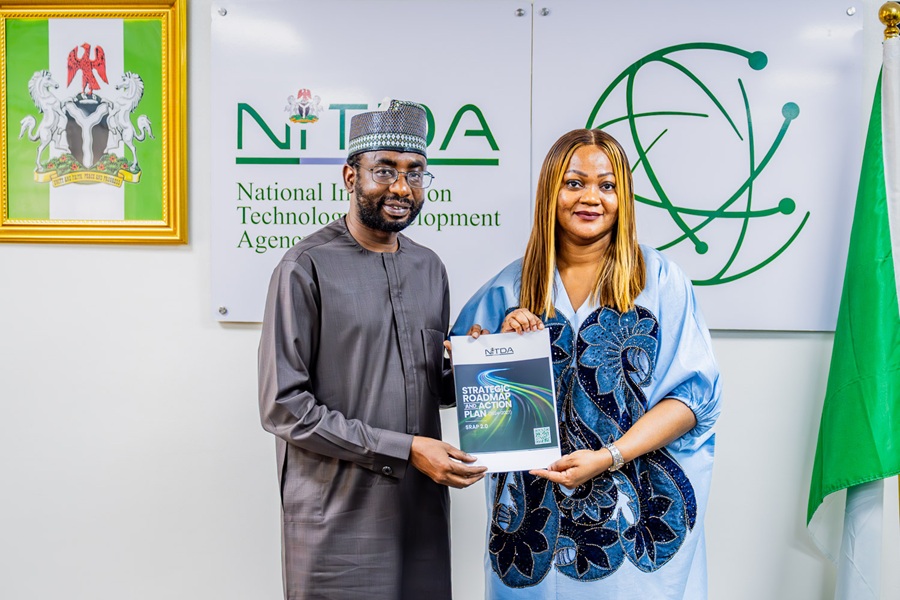
Nigeria’s journey toward a secure and fully integrated digital identity ecosystem reached another significant milestone as the National Information Technology Development Agency (NITDA) transferred its Public Key Infrastructure (PKI) framework to the National Identity Management Commission (NIMC).
The handover, which includes the underlying technology, operational systems and related assets, is expected to provide the trusted security foundation for Nigeria’s evolving digital identity architecture, enabling safer authentication, secure digital transactions and stronger protection of citizens’ data.
The development was announced during a courtesy visit by NIMC’s leadership to NITDA headquarters, where the two agencies formalised the transfer.
Speaking at the ceremony, Kashifu Inuwa Abdullahi, director-general of NITDA, described the move as more than an inter-agency asset transfer. According to him, it reflects the Federal Government’s growing commitment to building a collaborative digital ecosystem where institutions leverage technology collectively to drive national development.
Inuwa explained that NITDA has invested years in laying the groundwork for Nigeria’s Public Key Infrastructure (PKI) and broader Digital Public Infrastructure (DPI) initiatives, positioning the agency to support NIMC in strengthening the country’s digital identity framework.
He assured that NITDA would continue working closely with NIMC throughout the transition to ensure the migration is seamless and the infrastructure remains resilient.
“The handover is not the end of our role,” he noted. “We will continue to work hand-in-hand with NIMC to ensure the infrastructure delivers maximum value to Nigerians.”
Public Key Infrastructure is regarded as one of the core technologies underpinning digital trust. It enables secure identity verification, electronic signatures, encrypted communications and authentication services, critical components for digital government services, online financial transactions and cross-platform identity management.
By placing the PKI infrastructure under NIMC, the government aims to consolidate Nigeria’s digital identity ecosystem under the agency responsible for managing the National Identity Number (NIN), creating a more integrated and secure platform for digital services across the country.
The move also aligns with Nigeria’s broader digital transformation agenda, where trusted digital identity and Digital Public Infrastructure are increasingly viewed as essential enablers of financial inclusion, e-government services, cybersecurity and economic growth.
As a technical framework, PKI enables the creation, management, verification, and authentication of digital identities using digital certificates. It serves as a vital tool for ensuring secure, trusted, and encrypted communications and transactions across the country. The handover directly supports the updated NIMC Act, recently signed into law by President Bola Ahmed Tinubu, which aims to harmonise identity databases across government agencies and establish the National Identification Number (NIN) as the cornerstone for identity verification, authentication, and public service delivery.
During the engagement, Inuwa also reaffirmed NITDA’s broader commitment to driving nationwide technology adoption. He emphasised that as Nigeria’s apex IT regulator, NITDA’s core mission is to help every citizen adopt and utilize technology, pledging ongoing support for NIMC and any other institution working to digitize their operations. He explained that NITDA’s mandate extends beyond regulation to fostering collaboration, supporting innovation, and ensuring digital solutions are inclusive for all. He further stressed that Digital Public Infrastructure is just as vital to economic growth as physical infrastructure and must remain secure, reliable, and accessible.

Engr. (Dr) Abisoye Coker-Odusote, NIMC director-general and CEO, thanked the NITDA leadership and highlighted the transformative potential of the newly enacted NIMC Act, which officially replaces a nearly two-decade-old framework from 2007.
She explained that the new law marks a structured, coded transition from a traditional identity database to a modern digital identity ecosystem.
This shift is designed to ensure seamless interoperability, security, and efficiency across both public and private sector platforms.
By moving away from old card-based systems toward secure digital credentials, the new framework is anchored on the principle of “one person, one identity,” giving every Nigerian a unique and verifiable digital presence.
The updated Act provides the essential legal backing for deploying PKI and other trust frameworks to secure these digital interactions.
To safeguard citizen data and maintain public trust, NIMC is rolling out this transition in carefully planned, gradual phases.
Both agencies emphasized that close cooperation is key to realizing Nigeria’s digital transformation goals. While NIMC manages the foundational identity backbone, NITDA will continue to focus on ecosystem development, regulation, and driving widespread tech adoption.
This alignment represents a unified step forward in building a secure, inclusive, and innovation-driven digital economy where all Nigerians can thrive.




