


There is a running joke among African tech observers that every founder in Nigeria eventually describes their product as “built for the African market.”
What made Thursday’s Pitchathon at The Gathering On 100 striking was how concretely several of its participants demonstrated what that phrase can actually mean when applied with rigour.
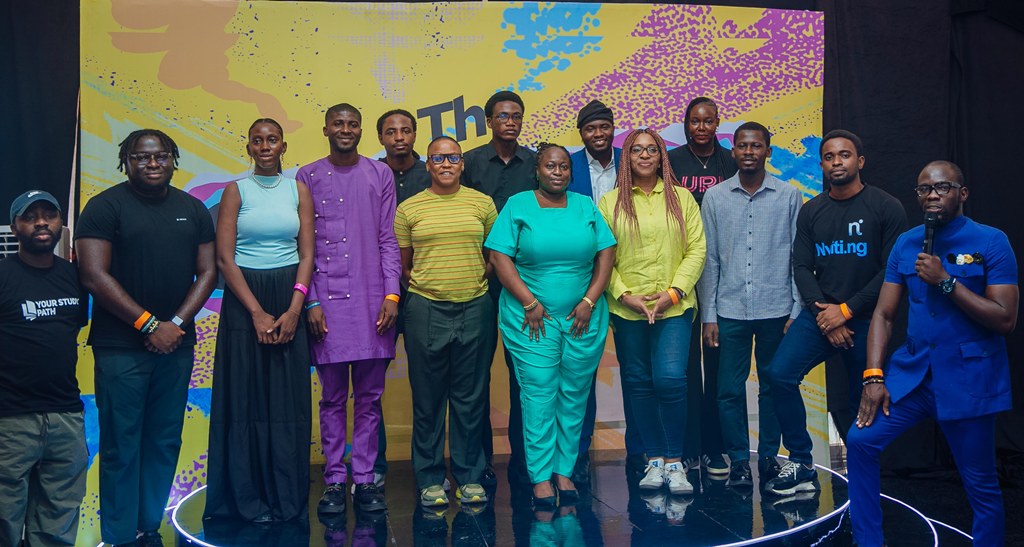
The competition, held at the National Stadium Surulere in Lagos on Thursday, 23 April 2026, brought together nine early-stage and growth-stage ventures whose solutions shared a common thread: they were built not around the assumption of reliable internet, well-banked consumers or digitally confident small business owners, but around the actual conditions on the ground in Nigerian and broader African cities.
Perhaps the most dramatic illustration of this came from Gideon Okubanjo’s Temi AI, an offline AI assistant running on Airtel Nigeria’s infrastructure that generates information, performs agentic tasks and processes financial transactions via a basic handset, at ₦18 per minute for voice and ₦6 for SMS.
The product earned ₦9 million across a three-month beta with roughly 400 daily users.
Three of Thursday’s nine companies independently arrived at the same architectural decision: WhatsApp as the primary user interface.
URI Social’s Jane, Invitee’s AI chatbot and Quad Limited’s shopping assistant all function through the messaging application rather than a bespoke dashboard, a convergence that reflects a wider shift in how Nigerian founders are thinking about distribution.
URI Social’s Precious Zino made the case most explicitly.
“There are so many businesses that would just never use ChatGPT,” she told judges who had questioned whether global AI tools might render her product redundant. “And ChatGPT doesn’t necessarily allow you to create content and post on social media at the same time.”
The argument is not simply that WhatsApp is convenient: it is that for the vendor selling clothes in Alaba or the hair salon owner in Ikeja, WhatsApp is already the operating system of their commercial life.
Building on top of it rather than asking them to migrate to something new is, in this reading, not a limitation but a strategic advantage.
Ravasend’s Emmanuel Isika offered a sophisticated version of the same argument in the payments space. Where most cross-border solutions route transactions through systems that are alien to the recipient, demanding a bank visit days after funds are sent.
Ravasend uses mobile money infrastructure, principally MTN MoMo, to ensure that a grandmother Nkechi, can receive money at a Momo agent immediately.
The company charges a flat 0.5% across all transactions, compared to the 7 to 15% that Isika said characterises incumbent corridors.
Judges pointed out the systemic risk in this model. One observed that MTN MoMo had the power to sever access to its rails at any moment, pointing to precedents in Ghana where operators without proper licensing had been cut off.
Isika’s response, which was that the company holds licensed partnerships, maintains bank-transfer fallback routes and is not entirely MoMo-dependent was accepted as credible but not, perhaps, fully reassuring.
The underlying tension the exchange exposed is one that many African fintech companies face: the infrastructure advantage of local partnerships can quickly become an infrastructure liability.
The afternoon served as a reminder that the ecosystem producing these companies is maturing.
The founders who took the stage on Thursday were, for the most part, not chasing fashionable technology themes: they were solving problems they had personally experienced, in markets they knew intimately, using channels their customers already trusted.
Whether that instinct translates into sustained commercial scale will be the question that the next phase of The Gathering 100 begins to answer.



