

For over a decade, Nigeria has been locked in a gruelling war of attrition. From the blood-soaked plains of the Northeast, where Boko Haram and ISWAP splinter cells mutate, to the dense forests of the Northwest, Middle Belt and South West, where ruthless bandit cartels execute mass kidnappings with impunity, the nation is bleeding.
Despite billions of naira funnelled into defence budgets, the Nigerian military frequently appears as hapless as the civilian population it is sworn to protect.
Troops are overstretched, intelligence is habitually compromised, and conventional infantry tactics are failing against a fluid, asymmetrical enemy. Public anxiety is mounting.
Meanwhile, thousands of miles away in Eastern Ukraine, a radical blueprint for modern survival is being drafted. Facing a severe manpower crisis and relentless aggression, Kyiv has digitised its frontline.
As detailed by CNN’s Nick Paton Walsh, the Ukrainian military is increasingly relying on an unmanned army, a network of reconnaissance drones, remotely piloted ground vehicles, and automated machine-gun nests operated by soldiers sitting in gamer chairs miles away from danger.
If Nigeria is to rescue its citizenry from the brink of total insecurity, the defence headquarters must abandon mid-20th-century conventional warfare.
It must embrace Ukraine’s brutal, brilliant realisation that in the face of a manpower crisis and an elusive enemy, technology must do the bleeding.
The Nigerian military’s current operational model is unsustainable. Soldiers endure gruelling, seemingly endless deployments in hostile terrain like the Sambisa Forest or the Kankara bush, leaving them physically exhausted and psychologically drained.
This mirrors the human toll seen in Ukraine, where frontline soldiers like Crow and Creepy spent nearly a year nonstop in dugouts. In Nigeria, this fatigue leads to catastrophic security lapses, vulnerable outposts, and a reactive military posture that only arrives after villages have been pillaged.
Ukraine’s technological evolution was born out of sheer necessity. By using unmanned ground vehicles (UGVs) and Unmanned Aerial Vehicles (UAVs), a single unit, the Third Assault Brigade, achieved the combat efficacy of 2,300 troops using a fraction of the personnel, effectively saving a thousand Ukrainian lives from the meat-grinder of the frontlines.
Now, Nigeria does not need multi-million-dollar fighter jets to turn the tide; it needs a decentralised, tech-driven doctrine.
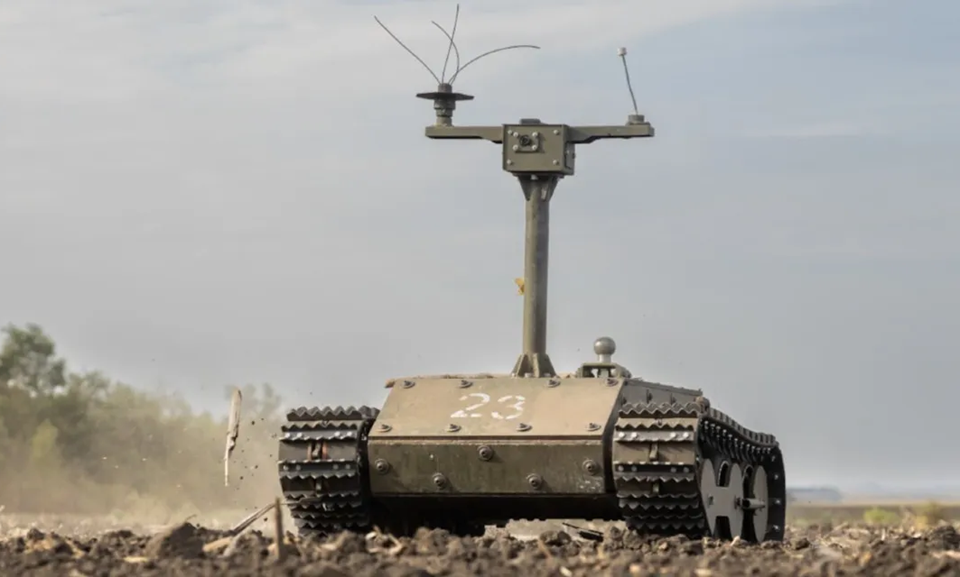
First, in Ukraine, embedded hardware and software engineers like 22-year-old Gora are the new frontline heroes. They modify cheap, four-wheel chassis robots to carry massive payloads of explosives directly into enemy trenches, machines the enemy has dubbed silent death.
Nigeria boasts one of the most vibrant tech ecosystems in Africa, centred in hubs like Yaba, Lagos. By partnering with local tech talent (think Terra Industries), the Ministry of Defence could mass-manufacture low-cost, rugged UGVs capable of navigating the rough terrain of the North. Instead of sending an infantry platoon to raid a suspected bandit camp, the military could send a vanguard of remote-controlled, explosive-laden rovers.
Secondly, one of the most terrifying aspects of Nigeria’s insecurity is the vulnerability of remote villages and boarding schools. Here, Ukraine’s “Ciber” unit provides a solution. They utilise heavy machine guns mounted on tank tracks that can hide in foliage for days without needing food, water, or sleep.
Deploying static, camouflaged, remotely operated weapon stations around vulnerable border towns and critical infrastructure would provide an instant, lethal deterrent.
Armed with wide-angle thermal cameras, a single remote operator in Abuja or Kaduna could police multiple perimeter checkpoints, cutting off bandit raid routes before they reach civilian centres.
In addition, ambushes on logistics convoys frequently cost the lives of Nigerian troops. Ukraine solves this by strapping ammunition, food, and water onto autonomous resupply robots that trundle down mud paths silently, guided by a pilot miles away in a bunker.
Implementing remote resupply units in theatre operations like Operation Hadin Kai would keep frontline forward operating bases stocked without risking valuable human lives on improvised explosive device (IED)-laden roads.
Moreover, the transition from traditional boots-on-the-ground to remote warfare requires a massive cultural shift. As Ukrainian commander Mykola “Makar” Zinkevych noted, old-school warfare relied on physical discipline and traditional soldiering. Today, technology decides everything.
The Nigerian military hierarchy has historically been rigid, top-heavy, and slow to adapt. To defeat syndicates that utilise modern encryption, social media for ransom negotiations, and highly mobile tech, the military must democratise its innovation.
Nigeria must empower its younger officers and civilian IT experts to build, hack, and deploy commercial drones and local software solutions without waiting for years of bureaucratic procurement.
Nigeria’s security forces cannot afford to continue fighting tomorrow’s war with yesterday’s strategy. The terrifying reality is that terrorists are adapting rapidly, utilising drones for their own surveillance and sophisticated weaponry bought with ransom money.
The military is not inherently helpless, but its current strategy is. By taking a page from Ukraine’s playbook, investing in domestic hardware engineering, deploying a network of silent death ground robots, and replacing vulnerable infantry patrols with eye-in-the-sky drone livestreams, Nigeria can finally shift from a defensive, traumatised posture to an offensive, clinical one.
Innovation is no longer a luxury for the Nigerian military; it is the sole remaining path to survival. Technology must take the place of the soldier on the frontline, so that the citizens may finally sleep in peace.
*Elvis Eromosele, a corporate communications professional and sustainability advocate, wrote via elviseroms@gmail.com.