


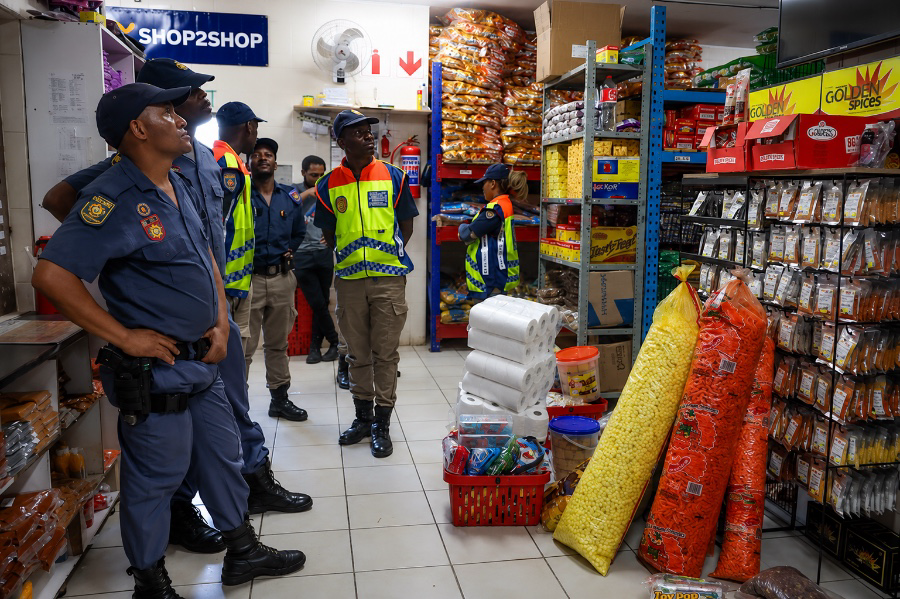
Hundreds of foreign-owned spaza shops, small neighbourhood convenience stores, have shut across parts of South Africa following weeks of anti-immigrant protests, leaving many township residents paying more for basic food items and exposing the problems in the country’s informal retail sector.
Although there is no official count of the closures, migrant advocacy groups say hundreds of shops have stopped operating in KwaZulu-Natal, Gauteng and the Western Cape.
The impact is already visible in many communities, where the price of everyday essentials has surged.
Bread, which sold for about R16 in some townships, now costs as much as R30, according to the Africa Diaspora Forum (ADF). The group says the increase is hitting low-income households the hardest.
“We don’t have a complete audit, but the number is in the hundreds,” ADF chairperson Amir Sheikh said. “Most of our members operate in the fast-moving consumer goods sector, selling everyday essentials like bread, sugar and other basic groceries. Those are the products where we have seen the sharpest increases.”
The spaza shop closures followed anti-immigrant protests and attacks that targeted businesses owned by Nigerians, Somalis, Ethiopians, Zimbabweans, Pakistanis and Bangladeshis in South Africa.
Some shop owners temporarily shut their businesses for safety, while others have not reopened.
While several people support greater local ownership of township businesses, many residents say higher prices have become an immediate concern as household budgets are unable to keep up.
Local shop owners admit they are finding it difficult to replace the business model many foreign traders built over the years. Many immigrant-owned businesses bought goods in bulk, shared supplier networks and secured better wholesale prices, allowing them to sell products more cheaply.
Without those buying networks, many South African-owned shops now purchase smaller quantities at higher prices, pushing up costs for consumers.
The issue has also drawn attention to the fate of South Africa’s estimated R900 billion township economy. Instead of focusing only on ownership, government officials and financial technology companies argue that technology will be indispensable in helping local retailers compete.
The Department of Small Business Development has already introduced a R500 million Spaza Shop Support Fund to modernise township retail.
The programme goes beyond financial support by providing point-of-sale (POS) systems, inventory management tools, digital payment solutions and business support services.
The government also plans to introduce an Integrated Payment Gateway and a National MSME Service Portal to make it easier for small businesses to access funding, government services and digital tools.
“Technology is expected to play a transformative role in the future of South Africa’s spaza economy by improving competitiveness, operational efficiency, financial inclusion and long-term sustainability,” Minister Stella Ndabeni-Abrahams said.
Modern POS systems now allow retailers to track stock in real time, monitor sales, automate ordering and build digital transaction records. Those records can also help small businesses qualify for loans because lenders can assess trading history instead of relying mainly on collateral.
Some retailers are already seeing the benefits.
Terry Gatsheni, who owns two convenience stores and a tavern in Thokoza, said technology has changed the way he manages his businesses.
“Before, you had to count everything by hand, and sometimes you’d only realise stock was missing when it was too late,” Gatsheni said. “Now the system shows us what’s coming in, what’s going out, and what we need to reorder. It makes running the shop much easier.”
Fintech company Lesaka Technologies believes digital tools, rather than nationality, will determine which retailers succeed in the coming years.
“I have spent my career serving the underserved, and what our data across more than 100,000 merchants shows and what I lived myself growing up in (rural) KwaZakhele, is that the most successful spaza is the one closest to its customer, priced for what the household can spend that day, open when people need it, and run by someone who knows their name,” Lesaka CEO Lincoln Mali said.
He argued that access to capital, reliable supplier networks and business data gave many foreign-owned retailers an advantage, not their nationality.
“Bulk-buying power isn’t magic,” Mali said. “It’s access to capital, supply and data, and that’s exactly the gap fintech should close for any operator, regardless of nationality or background.”
Residents say the effects are becoming harder to ignore.
“The prices in some of these spaza shops have been steadily rising since the unrest,” said Cosmo City resident Lelo Mathe. “I hope things stabilise because we’re not going to get any salary increases to match these prices.”
Others say some spaza stores in South Africa are carrying fewer products because owners fear further unrest and looting.


