

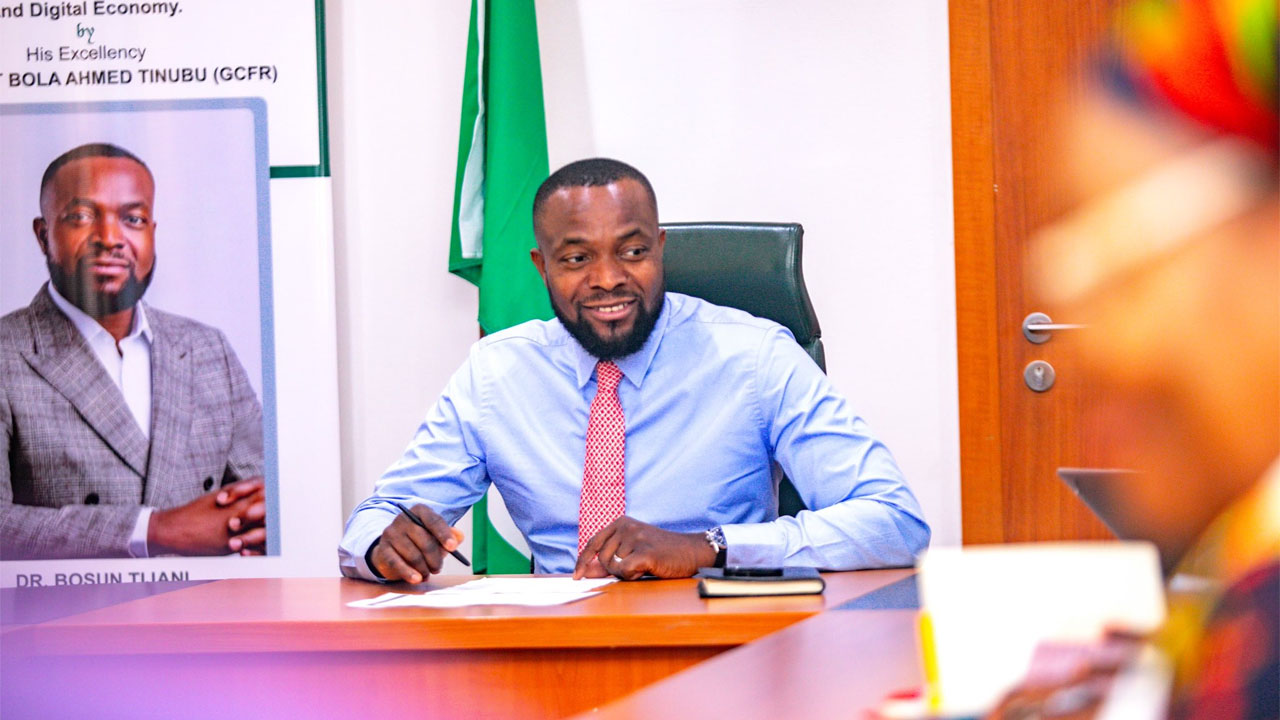
Nigeria has officially relaunched its Digital Switch Over (DSO) programme, marking an important step in the country’s long-delayed transition from analogue to digital broadcasting.
While the federal government has described the initiative as a key milestone in Nigeria’s digital transformation drive, many citizens say more urgent challenges in the telecommunications sector still need attention.
Nigeria Launches ‘FreeTV’: A New National Platform Offering 100+ Channels Without Subscription Fees
The latest rollout, championed by Bosun Tijani, the minister of Communications, Innovation and Digital Economy, revives a project that has suffered years of delays despite repeated commitments by successive administrations.
Speaking at the launch, Tijani described the Digital Switch Over as the fulfilment of a longstanding national goal and an important part of Nigeria’s broader digital development agenda.
“The launch of Nigeria’s Digital Switch Over (DSO) marks the actualisation of a longstanding dream to transition our broadcasting from analogue to digital,” the minister said.
According to him, the project shows President Bola Ahmed Tinubu’s commitment to investing in infrastructure that can support economic growth and national development over the long term.
Nigeria committed to digital migration more than a decade ago under global broadcasting reforms coordinated by the International Telecommunication Union (ITU).
However, multiple deadlines were missed, while pilot projects in selected states failed to lead to nationwide implementation due to funding challenges, policy inconsistencies, infrastructure gaps and regulatory hurdles.
The latest relaunch is therefore seen as one of the strongest attempts yet to complete a programme that many industry stakeholders consider long overdue.
Tijani said the benefits of the DSO go beyond television broadcasting.
According to him, the initiative uses NigComSat’s satellite infrastructure to improve access to information, educational content, cultural programming and digital services across the country, particularly in underserved communities.
“The DSO represents a major advancement for broadcasting whose significance extends far beyond television.
“By leveraging NigComSat’s satellite infrastructure, Nigerians can benefit from clearer access to information, broader educational and cultural content, improved quality of service, and greater inclusion, ensuring that no one is left behind simply because of where they live,” he said.
The minister also linked the programme to the administration’s wider digital infrastructure plans.
He disclosed that the federal government is pursuing the deployment of 90,000 kilometres of open-access fibre infrastructure through Project BRIDGE, a nationwide connectivity initiative designed to connect communities, businesses, institutions and public services.
In addition, President Tinubu has approved investments in two new satellites expected to strengthen Nigeria’s communications capacity and support digital service delivery.
“The Digital Switch Over is one of the first visible benefits of a much larger national digital infrastructure strategy. Under this administration, Nigeria is embarking on the deployment of 90,000 kilometres of open-access fibre infrastructure through Project BRIDGE, connecting communities, businesses, institutions, and public services across the country.
“At the same time, Mr President has approved investments in two additional satellites that will further strengthen our capacity in communications and digital services.”
Despite the government’s optimism, reactions on social media show many Nigerians are judging digital transformation by everyday experiences such as network quality, data affordability and access to reliable services.
Responding to the minister’s announcement on X, Olugbenga Ogundipe (@OlugbengaOgund6) said consumers expected greater improvements in the telecommunications sector.
“Honourable Minister. We expect much more transformation in our telecommunication sector than what’s on ground. Poor network, expensive data, and allocating one’s SIM number to another person when not used for some time, validity date for data which poor network does not allow one,” he wrote.
Another user, Uzor Malasowe (@uzur1), welcomed the initiative but argued that reducing the cost of internet access should receive greater attention.
“Sir, as laudable as this sounds, providing cheaper data to enable internet access would have been better,” he said.
A third user, identified as @DonMiccollo, urged the ministry to deploy more technology-driven solutions to address insecurity across the country.
“Your ministry should be at the forefront of harnessing technological knowledge and alternatives to combat insecurity,” the user wrote.
The reactions mirror a wider debate around Nigeria’s digital transformation efforts. While projects such as the Digital Switch Over, fibre expansion and satellite investments are widely viewed as necessary for long-term growth, many Nigerians remain focused on immediate concerns including poor network service, rising telecom costs and the practical benefits of technology in daily life.
The relaunch of the Digital Switch Over programme is undeniably a renewed momentum in Nigeria’s digital infrastructure drive.
However, public reaction shows that many citizens will not measure its success just by new infrastructure, but by whether it leads to better connectivity, more affordable internet access and tangible improvements in their everyday lives.