

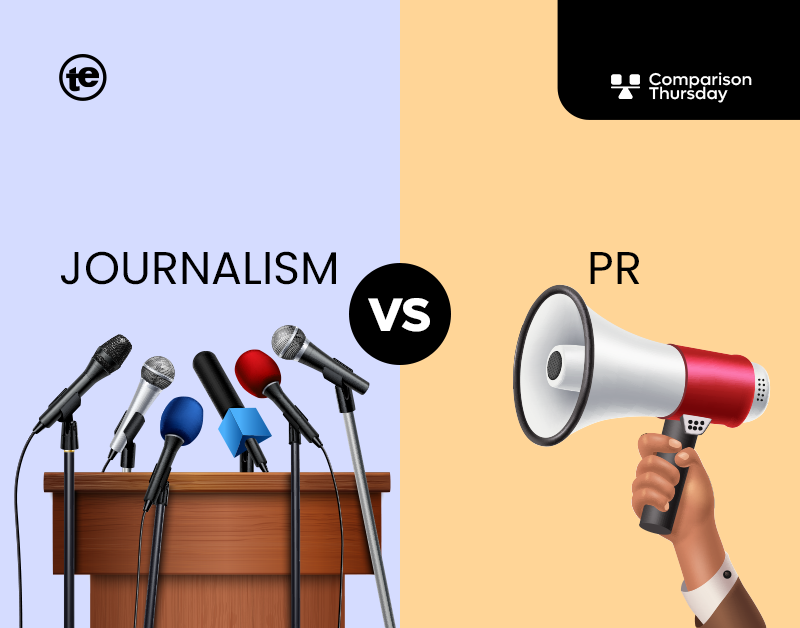
Over 60% of journalists say they receive more than 100 PR pitches every week, but less than 10% of those pitches ever become published stories.
This gap already says a lot about the relationship between journalism and public relations.
In 2026, the global public relations industry is valued at over $114 billion and still growing. At the same time, journalism is facing challenges such as shrinking newsrooms, high legal threats, and declining press freedom across more than half of countries worldwide.
These two forces do not operate in isolation, instead, they collide every day, in press statements, and breaking news cycles and crisis moments where the story is still being created.
Both sides work the same story from different directions. While one tries to shape it, the other tries to verify it, with the public sitting in the middle, deciding what is true.
The opening move: who speaks first often shapes everything
When a company faces a scandal, a policy change, or a product failure, PR teams move first. A statement is drafted, with key phrases chosen carefully, tone is controlled and timing is strategic.
Journalists, meanwhile, begin asking different questions:
- What actually happened?
- Who is responsible?
- What evidence supports this?
The first version of the story is usually not the final one, but it can be the most influential. In the news environment, early framing is important.
What journalism actually does
Journalism is built around one central function, which is public accountability through verification. Its role is not to protect organisations but to examine them.
That includes:
- checking claims before publication
- challenging official statements
- sourcing independent evidence
- publishing findings that may be uncomfortable for powerful actors
But journalism today is under stress. Press freedom has declined to its lowest level in 25 years, with more than half of countries now classified as having “difficult” or “very serious” conditions for media work.
In some cases, legal pressure is used even before stories are published. Media organisations report high use of lawsuits and legal threats as a way to discourage investigation itself.
This shouldn’t be ignored because journalism only works when it can challenge power without fear.
What PR actually does
Public relations is usually misunderstood as simple spin but it is more structured than that.
At its core, PR is about managing how organisations communicate with the public, investors, regulators, and customers.
That includes:
- drafting official communication
- managing reputation during crises
- maintaining media relationships
- translating corporate decisions into public messaging
The PR industry is now worth more than $114 billion globally, with steady expansion driven by digital media and real-time communication demands.
PR is not always reactive, as in many cases, it is proactive, building narrative before any crisis exists. But it operates with a clear priority, where the organisation’s reputation comes first.
The dependency nobody admits openly
Journalism and PR depend on each other more than they admit.
Journalists rely on PR for:
- official statements
- data releases
- access to spokespeople
- clarification during fast-moving events
In fact, a significant share of journalists say they depend on PR professionals for research and information gathering.
PR relies on journalists for:
- credibility
- public reach
- third-party validation
- long-term narrative authority
But the relationship is uneven, because PR can distribute a message, but journalism decides whether it becomes news.
The conflict between the two systems is seen daily in newsroom decisions.
1. Control vs independence
PR aims to control messaging, while journalism resists control.
2. Speed vs accuracy
PR pushes immediate response, but journalism prioritises verification.
3. Reputation vs accountability
PR protects the brand, journalism tests it.
4. Access vs pressure
PR controls access to information, journalism risks losing that access if it becomes too critical.
Both systems are designed to do different jobs.
The separation between journalism and PR is no more as clean as it once was.
Today:
- branded content looks like news
- corporate messaging spreads through social platforms without media filters
- influencers now function as informal PR channels
- newsrooms rely more on press releases due to reduced staff
At the same time, audiences are fragmenting. Global trust data shows fewer people now consume information from sources that challenge their views, shrinking shared understanding of reality itself.
This creates a new environment where perception is not built in one place, but across many small, overlapping channels.
A truth about influence
PR usually determines the first draft of public perception, while journalism creates the lasting version. The difference between the two is time, verification, and independence.
One works in minutes, the other works in days, sometimes weeks. But over time, it is the verified version that tends to stay.
Journalism and PR are not enemies but two different systems built for different results. PR builds narrative and protects reputation, while journalism tests it and protects public understanding.
Neither fully controls perception alone, but together, they create what the public eventually believes happened.
And with trust being fragmented and information moving faster than verification, that balance is more important now.